
Living in Cheverly, MD: A Complete Neighborhood Guide for Home Buyers (2026)
By Ryan Hehman | ryanhehmanrealestate.com | Route 1 Corridor & Prince George's County Specialist
Cheverly is one of the best-kept secrets in the DC metro area, and the buyers who discover it tend to stay for decades. This is a town with its own Metro station on the Orange Line, a 66% homeownership rate that would be remarkable anywhere in the region, no HOA, a community pool that has been operating since 1955, a volunteer-run farmers market, and streets that were deliberately designed to follow the rolling contours of the land and preserve the tree canopy — all of it within about four miles of the US Capitol. Washington Magazine has called it one of the best places to live in the DC area. People who live here call it an island of green.
As of early 2026, the median home price in Cheverly sits around $487,000–$532,000 depending on source and time period — moderately above the Route 1 corridor communities to the west, and well below what comparable Metro-walkable communities in Montgomery County or Northern Virginia command. Homes are sitting on market approximately 54 days on average, and the market has cooled modestly from recent peaks. For buyers who want a genuine community — not just a place to sleep near DC — Cheverly is worth understanding in detail.
Where Is Cheverly, MD?
Cheverly is an incorporated town in Prince George's County covering approximately 1.35 square miles, with a population of roughly 6,200 residents. It sits just inside the Capital Beltway (I-495) east of DC, bounded by US Route 50 to the north, the Baltimore-Washington Parkway to the east, and Cheverly Avenue connecting the community to the major highways. The Cheverly Metro station on the Orange Line is located at the town's southern edge, just south of Route 50, making it one of the most walkably Metro-accessible communities in Prince George's County.
Cheverly was conceived as one of the earliest planned communities in the Washington area. The land was first platted in 1904 as Cheverly Gardens, a 93-acre development near the Landover railroad station. Robert Marshall, president of the Washington Suburban Realty Company, purchased the property in 1918 and moved into the existing 1839 Magruder family plantation house — known as Mount Hope — becoming Cheverly's first resident in 1919. Marshall's vision for the community was explicit in his original marketing: he advertised Cheverly to government workers as 'ten cents and twelve minutes to downtown Washington, D.C.' by rail. That transit-oriented founding vision, over a century old, is baked into Cheverly's physical design.
Marshall laid out Cheverly's streets to follow the natural contours of the rolling terrain rather than imposing a rigid grid — a design philosophy that gives the town its distinctive character of winding, tree-canopied lanes. The first 34 houses were built between 1921 and 1925, most of them mail-order homes from Sears & Roebuck and the McClure Homes Company. When the stock market crash of 1929 bankrupted Marshall's company, Cheverly's residents took control themselves and incorporated the town in 1931 — during the Great Depression — to ensure they could maintain their own streets and services. That self-reliant, civic-minded founding character has never left.
Mount Hope, the antebellum plantation house that Marshall restored and which sits at 1 Cheverly Circle on a ridge at the center of town, is on the town's official seal and was listed on the National Register of Historic Places in 1978. It remains a visible anchor of Cheverly's history and landscape today — a 12-room home built in 1839 that predates the town itself by nearly a century, and a reminder that the land Cheverly occupies has a complex history that extends far beyond the planned community era.
What Makes Cheverly Different: Civic Life as a Feature, Not a Slogan
Cheverly is genuinely different from every other community on the Route 1 corridor in one specific way: it has a level of civic engagement and community infrastructure that most suburbs half its age have never developed. This is not accidental. It is the direct product of a community that has been self-governing since 1931 and has built its social institutions over nearly a century.
The Cheverly Swim and Racquet Club — the community pool — has been operating since 1955. For context, that means Cheverly has had a functioning community pool for 70 years. It serves as the social center of Cheverly summers in a way that purpose-built amenities in newer communities rarely achieve, because it has had seven decades to accumulate the community rituals and relationships that make a place genuinely feel like home.
The Cheverly Community Market is a volunteer-run farmers market that brings local farmers and artisans together, typically operating during the second half of the year at the Cheverly Community Center. It offers local produce, baked goods, wine, fish, and prepared food, with live music from local artists. It is the kind of market that communities with more money and more marketing try to manufacture, and that Cheverly simply has.
The community holds Cheverly Day annually — a celebration with food, live music, and sports — plus seasonal events for Halloween, Easter, and Christmas that draw the whole town together. The American Legion Post 108 at 3608 Legion Drive functions as a community gathering place for civic events and veteran support. The Boys and Girls Club manages youth sports leagues. The Cheverly Soccer Club coordinates youth soccer. These are not amenities added by a developer to sell homes. They are institutions built by residents over decades.
One governance detail worth knowing that sets Cheverly apart from virtually every other Maryland community: residents 16 years of age and older, regardless of citizenship status, can vote in Cheverly's local elections. This policy, adopted by the town, reflects the community's commitment to inclusive civic participation and has made Cheverly a frequently cited example of local democracy done thoughtfully. For buyers who care about the character of local governance, this is not a minor detail.
There is no HOA in Cheverly. The town government provides the civic framework — street maintenance, community events, parks — without the private governance layer that HOAs impose. This is a significant quality-of-life difference for homeowners who have lived under HOA rules elsewhere and value the freedom of genuine homeownership.
Cheverly Real Estate: What to Expect in 2026
Here is the current market picture for Cheverly as of early 2026:
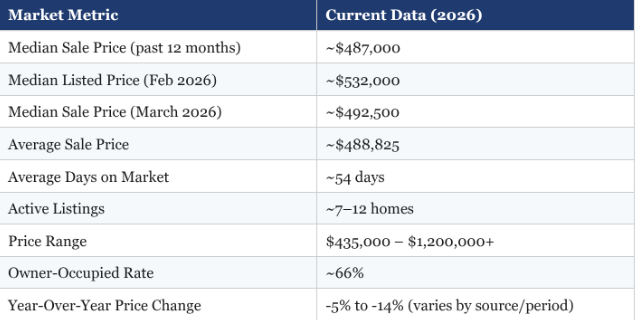
The data tells a nuanced story. Cheverly's median prices are modestly down from recent peaks — the -14% price-per-square-foot figure from Movoto likely reflects period-specific volatility in a thin market rather than sustained decline, while the more stable sale price data shows a moderate -5% year-over-year trend. Either way, the directional signal is clear: this is a buyer's market relative to the last several years, and buyers have more room to negotiate than they did in 2021-2023.
The 66% homeownership rate is worth pausing on. For context, the Prince George's County overall homeownership rate is approximately 55%, and many inner-Beltway communities run 40% or lower. Cheverly's 66% reflects a community of committed, long-term residents who chose this place deliberately — not renters cycling through, not investors treating houses as income streams, but owners who stay. That stability is part of what makes Cheverly feel the way it does, and it is also part of why inventory is perpetually thin.
The housing stock is predominantly small-to-mid-sized red brick single-family homes — Cape Cods, Colonials, ramblers, and ranch-style houses built primarily in the 1940s through 1960s, on generous lots with mature tree cover. There are no apartment complexes within the town's residential core, though a few apartment buildings sit at the town's edges near major roads. The architectural character is cohesive without being monotonous: the winding street grid creates varied streetscapes, and the mature canopy gives even modest homes a setting that newer developments cannot fake.
Cheverly's Sub-Areas
Cheverly has several identifiable sub-areas that buyers encounter in listings. The town proper — with the winding streets and older brick homes — is the core that most buyers are seeking. Cheverly Gardens (near the apartment complexes at the town's edge) has a more varied character. Cheverly Hills and Cheverly West offer somewhat newer construction and different street patterns. The 'Hill' section around Cheverly Avenue and Cheverly Circle features the grandest and oldest homes, including properties closest to the historic Mount Hope site. For buyers, the town proper and the Hill section generally represent the most sought-after inventory.
How Cheverly Compares to the Route 1 Corridor and Nearby Communities
vs. Hyattsville Arts District: Hyattsville runs $50,000–$100,000 lower on median prices but carries a higher dual city-plus-county tax burden, more commercial walkability, and more arts-district identity. Cheverly has the Metro station on the Orange Line (vs. Hyattsville's bus-to-Metro), substantially higher homeownership rate, and the pool and community infrastructure.
vs. Riverdale Park: Comparable median prices, but Riverdale Park has two Purple Line stations and the Whole Foods town center. Cheverly has the existing Orange Line Metro station and the stronger long-term community cohesion.
vs. College Park: Comparable prices with similar suburban feel. College Park has the UMD economic engine and Purple Line coming. Cheverly has the Orange Line Metro directly, no city tax dual burden ambiguity, and higher owner-occupancy.
vs. Greenbelt (adjacent to the north): Similar community character and price range. Greenbelt has the Roosevelt-era planned community history and Green Line/MARC access. Cheverly has the Orange Line.
vs. Capitol Hill / DC neighborhoods: $200,000–$400,000+ more expensive for equivalent space. Cheverly provides many of the same DC commute benefits at a fundamentally different price point.
Property Taxes in Cheverly: What You Actually Pay
Cheverly has a dual property tax structure — Prince George's County taxes plus a town municipal rate — which is similar to Hyattsville and College Park. However, Cheverly's town tax rate is generally modest, and the overall combined burden is reasonable relative to the level of community services and infrastructure residents receive.
Cheverly Property Tax Estimate (2026)
Prince George's County rate: ~1.19% of assessed value
Town of Cheverly: additional municipal rate (verify current rate with the town)
On a $490,000 home (approximate):
County portion: ~$5,831/year
Town portion: additional amount at current municipal rate
Combined estimate: comparable to or slightly above Riverdale Park; below Hyattsville
Important advantage: Cheverly does NOT have an HOA — there are no HOA fees on top of taxes.
Always verify the current combined rate with Prince George's County and the Town of Cheverly before closing.
The no-HOA fact deserves emphasis for buyers coming from communities where HOA fees are standard. In comparable Metro-area suburbs with similar community amenities — pools, parks, maintained common areas — HOA fees of $200-$600 per month are common. In Cheverly, the town government provides the civic infrastructure and the Swim Club operates as a member-supported institution rather than an HOA-mandated fee. The net monthly cost of ownership is meaningfully lower than the purchase price and tax rate alone would suggest, compared to HOA-governed communities.
Getting Around: The Orange Line Advantage
Cheverly's transit story is straightforward and strong: it has its own Metro station. The Cheverly station is on the Orange Line, located just south of Route 50 at the town's southern edge. This is the feature that differentiates Cheverly from virtually every other community in this guide, all of which either lack a Metro station entirely or require a bus connection to reach one.
Cheverly Metro Station (Orange Line)
From Cheverly station, the Orange Line runs west through DC — Minnesota Avenue, Deanwood, Stadium-Armory, Eastern Market, Capitol South, Federal Center SW, L'Enfant Plaza, Smithsonian, Federal Triangle, Metro Center, McPherson Square, Farragut West, Foggy Bottom, Rosslyn — and continues through Arlington and out to Vienna/Fairfax. For buyers who work downtown, on Capitol Hill, at L'Enfant Plaza-area federal agencies, or at the DC end of the Orange Line corridor, Cheverly is genuinely convenient in a way that few Prince George's County communities can claim.
The station also offers parking — a rarity for closer-in Metro stations — with daily weekday rates in the $4.95–$5.20 range. Weekend and holiday parking is free. For buyers with occasional driving needs but a primary transit commute, this is a practical combination.
Peak frequency on the Orange Line is every 6 minutes during rush hours. Off-peak service runs every 12 minutes. The commute to Metro Center is approximately 15-20 minutes from Cheverly — fast enough to make genuinely car-free DC commuting practical for most riders.
Driving Access
For buyers who do drive, Cheverly's position between Route 50 and the Baltimore-Washington Parkway provides excellent regional access. Route 50 connects west into DC via New York Avenue and east toward Annapolis. The BW Parkway connects north toward BWI and Baltimore and south toward DC. I-495 (the Beltway) is accessible within a few minutes. For commuters with jobs in suburban Maryland, Northern Virginia, or anywhere along the regional highway network, Cheverly's highway access is genuinely strong.
MARC Rail — New Carrollton
New Carrollton — which serves as a terminal for the Orange Line Metro and hosts MARC commuter rail service and Amtrak connections — is two stops east of Cheverly on the Metro. For buyers who occasionally need MARC or Amtrak service, New Carrollton's accessibility via Metro makes Cheverly more transit-flexible than its direct bus options alone would suggest.
Schools in Cheverly
Cheverly falls within Prince George's County Public Schools. The primary schools serving the town are Gladys Noon Spellman Elementary School (serving most of Cheverly), G. James Gholson Middle School, and Bladensburg High School. School ratings in this area reflect the mixed performance profile common to urban PG County schools, and buyers with school-age children should research specific schools and PGCPS magnet program options carefully at the address level.
Private school options accessible from Cheverly include DeMatha Catholic High School in Hyattsville, Elizabeth Seton High School, and St. Ambrose Catholic School — all cited by local real estate listings as options that Cheverly families frequently use. The town's strong civic culture and high homeownership rate tend to produce engaged, supportive school communities even where the institutional ratings are mixed.
Cheverly is also adjacent to the broader educational ecosystem of the DC metro area. For buyers whose children are approaching high school age, the combination of public school options, PGCPS magnet programs, and private schools within driving distance gives Cheverly families a realistic range of choices.
Who Lives in Cheverly?
Cheverly's population of approximately 6,200 is more diverse than its planned-community-for-government-workers origin would suggest. The community has evolved over nearly a century into a genuinely mixed demographic — racially, economically, and politically — that reflects the DC metro area's broader character.
The median household income runs approximately $95,000, above the Prince George's County average but not in the range of the wealthiest inner-Beltway communities. The median age is approximately 37-38 years. The homeownership rate of 66% is among the highest of any inner-Beltway community in PG County and reflects the long-term resident base that self-selecting town governance tends to produce.
The typical Cheverly buyer is someone who did their research. This is not a neighborhood people stumble into — it is one they find after specifically looking for Metro walkability, a real community identity, no HOA, and a reasonable price point inside the Beltway. The resident population skews toward:
Federal employees and government contractors who use the Orange Line daily and value a short, reliable commute to Capitol Hill, L'Enfant Plaza, and the Federal Triangle employment cluster
DC-area professionals — lawyers, advocates, journalists, academics — who want to own a house with a yard in a real neighborhood without paying DC or Northern Virginia prices
Families with young children who value the community pool, the neighborhood parks, the no-HOA environment, and the town's strong civic programming
Long-term DC-area residents who have rented in the city for years, know what a real neighborhood looks and feels like, and are specifically seeking that in Maryland
Move-up buyers from elsewhere in Prince George's County who want the Metro access and community infrastructure that Cheverly offers at a step up from their current neighborhood
What residents consistently cite when asked why they chose and stayed in Cheverly: the neighbors know each other. The community pool creates a summer social network. The farmers market creates a weekly gathering rhythm. Cheverly Day and the seasonal events create a calendar of shared experience. These are the things that make a neighborhood feel like a community, and Cheverly has them in a way that most suburban communities — newer, larger, and better-marketed — simply do not.
What Daily Life Looks Like in Cheverly
Daily life in Cheverly centers on the town's green infrastructure and community institutions more than on commercial amenity density. The town itself has limited retail — an Aldi and CVS at the Cheverly Terrace shopping center near the Metro station, Three Brothers Italian Restaurant, and a handful of other small businesses. Most dining and shopping happens in nearby communities — Hyattsville and the Route 1 corridor are accessible by Metro or a short drive.
What the town does exceptionally well is outdoor access and community programming. Cheverly Nature Park, Bellamy Park, Town Park, and multiple neighborhood green spaces are threaded through the community's winding streets, giving residents genuine outdoor access without leaving the neighborhood. The winding street design that Robert Marshall built to follow the natural terrain means that even a walk around the block involves topography, tree canopy, and sight lines that feel more interesting than the flat grids of most postwar suburbs.
The Cheverly Swim and Racquet Club is the summer center of gravity for the community. Parents bring children; neighbors catch up; summer evenings at the pool become the setting for the kind of casual, recurring social interaction that builds real community over years. For families with children, this is not a minor amenity — it is the social infrastructure of childhood summers.
The Cheverly Community Market, running during the second half of the year at the Community Center, brings local farmers and artisans into the neighborhood on a regular basis. The live music component and the casual social atmosphere make it a weekly gathering as much as a farmers market.
Community Forklift — the large reuse warehouse where residents can find donated furniture, appliances, and home décor — is located at the town's edge near Edmonston and is a practical resource for homeowners updating older homes. The monthly Forklift First Friday event extends into the evening with local bands and food trucks, creating a community gathering point that spans multiple corridor communities.
For residents who need more urban amenity, the Orange Line Metro to Capitol Hill, Eastern Market, and downtown DC is 15-20 minutes away. This is Cheverly's core value proposition: you can live in a quiet, tree-canopied town with a community pool and neighbors who know your name, and be at the Smithsonian or the Capitol in twenty minutes.
What to Watch For When Buying in Cheverly
Home age and condition: The majority of Cheverly's housing stock was built in the 1940s through 1960s. These are well-built, solid brick homes, but they are 60-80 years old. Inspect carefully. Older electrical panels, original plumbing, HVAC systems approaching end of life, and lead paint are all possibilities. The good news is that the high homeownership rate and civic culture in Cheverly tend to produce well-maintained homes — residents who stay for decades generally take care of their properties. But never waive the inspection contingency.
Metro station proximity vs. walkability within town: The Cheverly Metro station is at the southern edge of the town, near Route 50 — not at the geographic center of the community. Some residential streets are a 10-15 minute walk from the station; others are closer to 20 minutes. The town is walkable in the sense that most internal destinations are reachable on foot, but buyers should map the specific walking distance from any property they're considering to the Metro station before assuming it's a 5-minute walk.
Route 50 noise: Properties on the northern edge of the town core, closest to Route 50, experience highway noise that properties on quieter interior streets do not. This is worth evaluating at the specific address level — Cheverly's topography and tree canopy buffer a lot of noise, but not uniformly across all streets.
Thin inventory: Like Cheverly's neighbors to the west, this is a market with limited listings at any given time. Seven to twelve homes actively listed means you are not browsing a deep catalog. Buyers who are serious about Cheverly need to be pre-approved and ready to move. Working with an agent who knows when properties are coming to market before they go live is a genuine advantage here.
The no-HOA tradeoff: No HOA means no monthly fees, no architectural review boards, and no private governance layer. It also means that your neighbor's property decisions are ultimately their own, within town code. For most buyers, the no-HOA environment is a strong positive. Buyers who specifically want HOA enforcement of community standards should understand what they are and are not getting here.
Frequently Asked Questions About Cheverly, MD
Is Cheverly a good place to buy a home in 2026?
Yes — particularly for buyers who prioritize Metro access, community identity, and long-term stability over dense urban amenity. Cheverly has its own Orange Line Metro station, a 66% homeownership rate that reflects genuine community stability, no HOA, a community pool operating since 1955, and prices that remain meaningfully below comparable Metro-walkable communities in DC, Montgomery County, and Northern Virginia. The market has cooled from recent peaks, giving buyers more room to negotiate.
What is the average home price in Cheverly?
As of early 2026, median sale prices are running approximately $487,000–$492,500, with median listed prices around $532,000. The price range runs from approximately $435,000 for smaller homes needing updates to over $1,200,000 for premium renovated properties. Average days on market is approximately 54 days. The market has approximately 7-12 active listings at any given time — thin by most standards.
Does Cheverly have a Metro station?
Yes. The Cheverly station is on the Orange Line, located just south of Route 50 at the town's southern edge. Orange Line trains run at peak frequency of every 6 minutes during rush hours, with off-peak service every 12 minutes. The commute to Metro Center is approximately 15-20 minutes. The station offers parking at daily weekday rates of approximately $4.95–$5.20, with free weekend and holiday parking. This is the feature that most distinguishes Cheverly from other inner-Beltway PG County communities.
Does Cheverly have an HOA?
No. Cheverly has no HOA. The town government provides community infrastructure and services, and the Cheverly Swim and Racquet Club operates as a member-supported institution rather than an HOA-mandated fee. For buyers who have lived under HOA governance and value the freedom of direct homeownership, this is a meaningful distinction. You own your home; the town manages public spaces and services; there is no private governance layer telling you what color to paint your shutters.
What makes Cheverly's community different from other suburbs?
The depth and age of its civic institutions. The community pool has been operating since 1955. The town incorporated in 1931 — during the Great Depression — when residents took control from a bankrupt developer and decided to govern themselves. The volunteer-run farmers market, the annual Cheverly Day celebration, the Boys and Girls Club, the American Legion Post, and the seasonal community events have all been built and maintained by residents over decades. Voters 16 and older, regardless of citizenship, can participate in local elections. This is not a suburb that was built by a developer and has been trying to create community ever since. It is a community that has been building itself for 95 years.
What are the property taxes like in Cheverly?
Cheverly has a dual property tax structure — Prince George's County taxes (~1.19% of assessed value) plus a town municipal rate. The combined burden is broadly comparable to other incorporated Route 1 corridor communities, though lower than Hyattsville's dual-tax structure and without the HOA fees that many comparably amenitized suburban communities carry. On a $490,000 home, expect a combined annual tax bill in the $6,000-$7,500 range depending on the current town rate — always verify directly with the county and the Town of Cheverly before closing.
How does Cheverly compare to the Route 1 corridor communities like Hyattsville and Riverdale Park?
Cheverly sits at a higher price point than Hyattsville and is roughly comparable to Riverdale Park, but it offers something neither of those communities has: a direct Metro station on the Orange Line. Hyattsville has more walkable commercial amenity density and arts-district energy. Riverdale Park has the Whole Foods town center and Purple Line proximity. Cheverly has the strongest transit infrastructure for Orange Line corridor commuters, the highest homeownership rate, no HOA, and a civic community built over nearly a century rather than a decade. For buyers whose commute runs along the Orange Line into DC, Cheverly is often the best fit on the entire corridor.
Ready to Explore Cheverly?
I'm a real estate agent with Compass who specializes in Prince George's County — Cheverly, the Route 1 corridor, and the broader inner-Beltway market.
Cheverly is one of the most rewarding communities to help buyers find their way into, precisely because so few people know it well. I can walk you through the specific streets and properties that represent the best value, the walking time from any listing to the Metro station, the school landscape at the address level, and what it actually costs to own here when you factor in the no-HOA environment. If Cheverly is on your list, let's talk.
I offer free, no-obligation consultations for buyers at any stage.
Email: Ryan.Hehman@compass.com
Call or Text: 443-990-1230
Or reach out directly through the contact page — I respond quickly and won't hand you off to an assistant.
Related articles:
Living in the Hyattsville Arts District: A Complete Neighborhood Guide for Home Buyers (2026)
Living in Riverdale Park, MD: A Complete Neighborhood Guide for Home Buyers (2026)
Living in College Park, MD: A Complete Neighborhood Guide for Home Buyers (2026)
Living in Mount Rainier, MD: A Complete Neighborhood Guide for Home Buyers (2026)
Living in Edmonston, MD: A Complete Neighborhood Guide for Home Buyers (2026)
DC vs. Maryland Suburbs: Where Should You Actually Live When Relocating to the DC Area?