

Living in Mount Rainier, MD: A Complete Neighborhood Guide for Home Buyers (2026)
There is a shorthand that locals on the Route 1 corridor use for Mount Rainier: 'Takoma Park at half the price and twice the diversity.' It's a little reductive, but it's not wrong. Mount Rainier sits directly on the DC border — the first Maryland city you reach heading northeast out of DC on Rhode Island Avenue — and it has the walkable, tree-lined, front-porch-culture character of a pre-car streetcar suburb that most suburban Maryland communities simply cannot replicate. It was designed for pedestrians a century before 'walkability' became a real estate buzzword, and that urban DNA is baked into every narrow street, front porch, and century-old bungalow in the city.
As of early 2026, the median listed price in Mount Rainier is approximately $505,000 — up in the range of Riverdale Park and meaningfully above Hyattsville, reflecting the city's DC-border premium and its unusually tight inventory. Homes are sitting on the market roughly 46-57 days. But the price headline doesn't capture the full picture: Mount Rainier has one of the most compelling value stories on the entire corridor for buyers who understand what they're getting. Here's what you need to know.
Where Is Mount Rainier, MD?
Mount Rainier is a small, incorporated city of approximately 8,300 residents covering less than one square mile in Prince George's County, Maryland. It was founded as a streetcar suburb in the early 1900s — the streetcar line from DC reached what would become Mount Rainier in 1897, and residents formally incorporated the town in 1910. The name comes not from the famous mountain in Washington State being visible, but from a deliberate choice by the original developers to borrow the name's romantic associations.
What makes Mount Rainier physically distinctive is the scale and integrity of its historic housing stock. The city was built out almost entirely between 1900 and 1940, and an astonishing proportion of those original buildings are still standing and still recognizable. The Mount Rainier Historic District was listed on the National Register of Historic Places in 1989 — covering 1,152 buildings, of which 1,001 are considered contributing resources to the historic district. The architectural range runs from Queen Anne and Shingle-style Victorians to Craftsman bungalows, American Foursquares, and Colonial Revivals, with twelve documented Sears, Roebuck & Company mail-order kit homes sprinkled across the residential streets.
The result is a city that looks and feels like a neighborhood that time preserved rather than one that developers built. Decades-old elm trees shade streets lined with front-porch bungalows set close together on small lots — a pre-car urban form that, as urbanists have noted, could not be legally built today under current Prince George's County zoning. Mount Rainier is also the most densely populated incorporated area in Maryland while still feeling like a quiet suburb. That paradox is the essence of the place.
The city is part of the Gateway Arts District, along with Hyattsville, Brentwood, and North Brentwood. Its commercial corridors along Rhode Island Avenue and 34th Street host approximately 84 active businesses, including a community of over 150 working artists who make Mount Rainier one of the most concentrated arts communities in the DC metro area.
The Arts Community: What Makes Mount Rainier Different
Mount Rainier's arts identity is not a marketing slogan applied to a neighborhood after the fact. It is a genuine, decades-old community that predates recent revitalization and continues to deepen. The National Endowment for the Arts recognized it with its 'Art Lives Here' creative placemaking initiative for good reason. The city has been home to working artists since long before Route 1 became a destination corridor.
The anchor institution is Joe's Movement Emporium — the largest independent performing arts center in Prince George's County. Founded in 1995 by Brooke Kidd and Ajax Joe Drayton in a leased storefront, it grew into a 20,000-square-foot performing arts center housed in a converted warehouse following a $3.2 million capital campaign, opening its current facility in 2007. Joe's serves over 70,000 visitors annually through daily movement classes, more than 150 public events per year, youth arts education programs, and a performance season spanning dance, comedy, music, and theater. It is located at 3309 Bunker Hill Road and is open seven days a week.
Alongside Joe's, the arts ecosystem includes:
Red Dirt Studio — a warehouse arts space on 34th Street that brings together developing and established artists for collaboration, studio work, and community programming. A new community darkroom was announced for Red Dirt Studio in February 2026, expanding its offerings for photographers and visual artists.
Washington Glass Studio — on Otis Street, a working studio where sculptors create large-scale commercial and architectural glass projects, with a partner school offering instruction in glassmaking to the public.
GLUT Food Co-op — a natural foods cooperative that has been a community institution in Mount Rainier since 1965, making it one of the longest-running food co-ops in the DC area and a symbol of the neighborhood's independent, community-minded character.
The Mount Rainier Craft Fair and annual performing arts events hosted by Joe's — community events that regularly draw visitors from across the DC metro area.
Mount Rainier Day — an annual event with over 100 years of continuous history, featuring a parade, live music, and community activities at the Mount Rainier Nature Center.
For buyers who have spent time in places like Takoma Park, Silver Spring's Arts District, or the Hyattsville Arts District, the Mount Rainier arts community will feel familiar but distinctly more grassroots and less commercialized. The 150-plus working artists who call this city home are not here because a developer branded the area. They are here because the affordable rents, historic spaces, and community tolerance attracted them decades ago and the community built itself around their presence.
Mount Rainier Real Estate: What to Expect in 2026
Here is the current market picture for Mount Rainier as of early 2026:
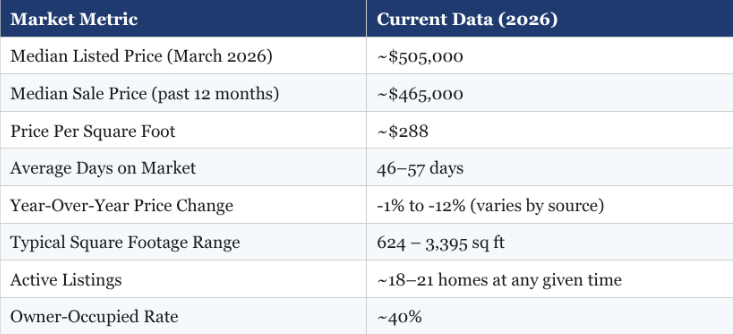
The data picture requires some interpretation. Mount Rainier is a very small city with a thin inventory — typically only 18 to 21 homes actively listed at any point. That means monthly statistics can be volatile, with one or two outlier sales swinging median figures significantly. The longer-term trend is one of steady appreciation from a low base, with price-per-square-foot running around $288 in March 2026.
The inventory mix is important context. Mount Rainier's housing stock runs from genuine fixer-uppers — historic bungalows that need full renovation and are priced in the mid-to-high $300,000s reflecting their as-is condition — all the way up to fully renovated 1920s craftsmen and larger colonials that trade at $550,000-$650,000+. The gap between unrenovated and renovated is wide here, wider than in most Route 1 corridor markets, because the historic housing stock requires significant investment to modernize. That gap is also the opportunity: a buyer who is willing to do a renovation, or who finds a well-maintained home at the right price, can acquire a genuinely special property at a meaningful discount to what a turnkey version would cost.
The Sears Kit Home Factor
Twelve documented Sears, Roebuck & Company mail-order kit homes have been identified in Mount Rainier, along with additional homes from Montgomery Ward and Aladdin catalog programs. These homes — ordered from catalogs, shipped by rail, and assembled on-site — are a specific draw for buyers who value architectural authenticity and historical significance. They are also eligible for specific tax incentive programs (discussed below). Listing agents in this market identify Sears models by name: a Sears Vallonia craftsman bungalow is a different and identifiable product from a generic 1920s bungalow, and buyers who know this can research the specific model's original floor plan and specifications.
How Mount Rainier Compares to the Route 1 Corridor
vs. Hyattsville Arts District: Hyattsville runs $80,000-$100,000 lower median prices but carries the dual city+county tax burden. Mount Rainier is smaller, more intimate, and sits directly on the DC border. Both are arts-district communities; Mount Rainier's arts identity is older and arguably deeper.
vs. Riverdale Park: Comparable median price range. Riverdale Park has the superior town center (Whole Foods, Riverdale Park Station) and two Purple Line stations. Mount Rainier has the DC-border location, National Register historic district, and more architectural character.
vs. Brentwood: Brentwood (adjacent to the east) typically runs $50,000-$100,000 lower but has less commercial corridor development and less arts-community identity. Worth considering for buyers who want the same general area at a lower price point.
vs. Takoma Park (MoCo): $150,000-$200,000 higher median for comparable homes. Takoma Park has a more developed commercial corridor and Montgomery County schools, but Mount Rainier has a very similar community character at a significantly lower price.
Property Taxes in Mount Rainier: The Full Picture
Mount Rainier is an incorporated city within Prince George's County, so buyers pay both county and city property taxes — the same dual-tax structure as Hyattsville, though with a different municipal rate.
Mount Rainier Property Tax Estimate (2026)
Prince George's County rate: ~1.19% of assessed value
City of Mount Rainier: additional municipal rate (verify current rate with city)
On a $480,000 home (approximate):
County portion: ~$5,712/year
City portion: additional amount based on current municipal rate
Combined estimate: higher than Riverdale Park but potentially comparable to Hyattsville
Always verify the current combined rate with Prince George's County and the City of Mount Rainier before making an offer.
There is an important offset that Mount Rainier offers that the other Route 1 cities do not: a meaningful historic property tax credit program. Because most homes in Mount Rainier built before 1945 are considered 'contributing resources' to the National Register historic district, they are eligible for the Maryland Heritage Structure Rehabilitation Tax Credit — a state credit equal to 20% of certified rehabilitation project costs. The City of Mount Rainier adds a supplemental credit of 10% of the state-approved costs on top of the state program.
What this means practically: a buyer who purchases an unrenovated historic bungalow and invests in a certified restoration — new windows compatible with the historic character, structural repairs, appropriate interior renovation — can recapture a meaningful portion of those costs through combined state and city tax credits. The minimum qualifying project is $5,000, and nearly all pre-1945 homes in the city qualify. This is a genuine financial incentive that makes the fixer-upper play in Mount Rainier more attractive than the raw purchase price might suggest.
The city also offers a separate tax credit for homeowners who install historically compatible windows and doors (10% of approved costs), and a 20% city tax credit for senior homeowners and military retirees who have lived in the same home for at least 30 years. These programs reflect an active commitment to keeping long-term residents and incentivizing historic preservation.
Getting Around: Transit Access from Mount Rainier
Mount Rainier does not have a Metro station within the city limits, and this is the most significant practical trade-off relative to Riverdale Park and College Park. But the transit picture is better than buyers often assume when they first look at the map.
Bus to Metro — Rhode Island Ave-Brentwood Station (Red Line)
The Rhode Island Avenue-Brentwood Metro station on the Red Line sits just across the DC border — close enough that some blocks in Mount Rainier are within reasonable walking distance, and bus service on Rhode Island Avenue connects directly to it. From Rhode Island Ave-Brentwood, the Red Line provides direct service to Union Station, Dupont Circle, Bethesda, and Shady Grove. For buyers commuting to the Northwest DC federal employment core, this is a practical route.
Bus to Metro — West Hyattsville Station (Green/Yellow Line)
The West Hyattsville station on the Green and Yellow lines is accessible via Metrobus from the Mount Rainier corridor. The Green Line connects directly to downtown DC (L'Enfant Plaza, Gallery Place, Columbia Heights) and continues north to College Park and Greenbelt. For buyers whose commutes run to the south side of downtown or the PG County employment corridor, this is the more useful connection.
Metrobus and Local Bus
Multiple Metrobus routes serve the Rhode Island Avenue corridor through Mount Rainier, connecting residents to both Metro lines and to DC neighborhoods directly. Route 83 (the same bus that serves the Hyattsville Arts District) runs through the Gateway Arts District corridor. PG County's TheBus became free for all riders in mid-2025, which meaningfully improves the car-free value proposition for residents who use local transit.
Driving
For buyers who drive, Mount Rainier's position directly on the DC border at Rhode Island Avenue gives excellent access into Northeast DC and to the Beltway via the Baltimore-Washington Parkway to the east. The commute into downtown DC by car runs 20-35 minutes depending on traffic. Route 1 connects north toward the rest of the corridor. The city's small size — less than one square mile — means that most daily driving needs are minimal for residents who work in DC or along the corridor.
Walkability Within the City
Mount Rainier's pre-car urban form means it is genuinely walkable within the city itself in a way that most Maryland suburbs are not. Narrow street grids, short blocks, sidewalks on most streets, and the commercial corridors along Rhode Island Avenue and 34th Street within walking distance of most residential blocks make car-free daily life more realistic here than the transit map alone suggests. The Levee Trail at the Mount Rainier Nature Center provides a paved path for walking and running. Capital Bikeshare stations are available in the area.
Schools in Mount Rainier
Mount Rainier is served by Prince George's County Public Schools. The schools serving the city have received mixed ratings, and this is an area where buyers with school-age children should do address-level research rather than relying on city-level summaries.
One asset worth knowing about is Northwestern High School, which houses the Jim Henson Visual and Performing Arts Program — a specialized arts magnet curriculum that prepares students for careers in dance, music, theater, and visual arts. For families with artistically oriented children who align with the community's arts identity, this program is a meaningful local resource. The school's namesake connection to Jim Henson, who grew up in the area, is a source of genuine local pride.
For buyers who prioritize school ratings as a primary decision factor, Mount Rainier requires the same careful research at the address level that the other Route 1 corridor communities do. The private school landscape includes DeMatha Catholic High School in Hyattsville and a range of options across the DC border. Many Mount Rainier families with school-age children explore PGCPS magnet programs and the broader range of options that DC's proximity enables.
Who Lives in Mount Rainier?
Mount Rainier has one of the most distinct community identities of any small city in the DC metro area. The city is roughly 54% Black or African American and 19% Hispanic, with a median age of approximately 36. It is highly diverse by any measure, and that diversity is part of the community's character rather than incidental to it.
The resident population skews toward buyers who specifically sought out this community rather than landing here by default. Mount Rainier attracts:
Working artists, musicians, performers, and creative professionals who want affordable studio space, a community of peers, and proximity to DC without DC prices
Long-term DC residents — often from Northeast DC neighborhoods like Woodridge or Brookland — who want to stay close to the city while getting more space for their dollar
Socially progressive homeowners who value racial diversity, walkable urbanism, and community civic life — the same profile that fills Takoma Park, but buyers who have been priced out of Takoma Park or who actively prefer Mount Rainier's more diverse character
Federal employees and government workers, particularly those working in Northeast DC or accessible via the Red Line
Renovation buyers who see the historic housing stock as an opportunity and understand how to navigate older homes
Buyers affiliated with universities and cultural institutions in the DC metro area who want to be close to the city in a community with genuine arts infrastructure
The community is characterized by high civic engagement — active neighborhood associations, regular engagement with city government, strong social networks through Joe's Movement Emporium and other community anchors. The city's official description captures something genuine: 'Old and new, progressive and conservative, Bible-belt fundamentalists, rock-ribbed traditionalists, activists, recluses, empty nesters, and young families: all are at home in Mount Rainier.' It is a genuinely pluralistic small city in a way that most suburban communities are not.
What Daily Life Looks Like in Mount Rainier
The rhythm of daily life in Mount Rainier is shaped more by the pedestrian scale of the city than by any single amenity. Front porches are used. Neighbors know each other. The sidewalks actually get foot traffic. This is rarer in Maryland's Route 1 suburbs than it should be, and buyers who have lived in genuinely urban neighborhoods before will recognize and appreciate it immediately.
The GLUT Food Co-op on Rhode Island Avenue — operating since 1965 — anchors the community's commitment to local and organic food and is both a grocery resource and a community gathering point. Farm-to-table restaurants, coffee shops, yoga studios, and local businesses line the Rhode Island Avenue and 34th Street commercial corridors. The city has approximately 84 operating businesses, most of them locally owned.
Joe's Movement Emporium's more than 150 annual public events mean that there is almost always something happening in the community — performances, workshops, classes, community gatherings. The Mount Rainier Nature Center adjacent to the Levee Trail provides a soccer field, educational nature exhibits, and an aquatic center. The Mount Rainier Community Garden gives residents access to plots for growing produce.
Mount Rainier Day — an annual celebration with over a century of continuous history — draws the entire community together each year with a parade, live music, and community activities. It is the kind of civic tradition that newer communities try to manufacture and historic communities simply have.
For residents affiliated with DC's cultural life, the DC border location means genuine access: Northeast DC neighborhoods like Woodridge, Brookland, and Edgewood are immediately adjacent across Eastern Avenue. The Red Line corridor into Northwest DC is accessible by bus. Buyers who have lived in DC itself and are moving to Maryland often find Mount Rainier the easiest cultural transition of any community on the corridor.
What to Watch For When Buying in Mount Rainier
Home age and condition: This is the most significant buyer-beware issue in Mount Rainier. The vast majority of the housing stock was built between 1900 and 1940. These homes are beautiful and historically significant, but they require an experienced eye and a thorough inspection. Lead paint, knob-and-tube wiring, older plumbing systems, original windows, and foundation issues are all possibilities. 'You have to be prepared for some of the aches and pains of an old home,' as one longtime agent in the market has put it. Never waive your inspection contingency in this market.
Renovation scope and cost: The gap between unrenovated and renovated prices in Mount Rainier is wide. A buyer purchasing an as-is historic bungalow at $380,000 may be looking at $100,000-$200,000 in renovation investment to bring it to full modern comfort and functionality. Factor this into your total cost calculation, and explore renovation loan products (FHA 203k, Fannie Mae HomeStyle) before assuming you need to fund improvements from savings.
Historic preservation requirements: Because most pre-1945 homes in Mount Rainier are contributing resources to the National Register historic district, certain exterior renovations require compliance with historic preservation guidelines. This is not prohibitive — it is actually the reason the neighborhood looks the way it does — but buyers planning significant exterior changes should understand the process before committing. The city manager can walk you through what requires prior approval.
Parking: Mount Rainier's pre-car street grid means that off-street parking is not universal. Some homes have driveways; many do not. On-street parking is competitive on some blocks. This is a known trade-off of the neighborhood's urban form, and buyers who commute by car daily should evaluate specific street-level parking conditions before committing.
The transit gap: Mount Rainier does not have a Metro station within the city, and for buyers who specifically need walkable Metro access, this is a meaningful limitation. Bus connections to both Red Line and Green/Yellow Line stations exist and are functional, but they add time to the commute compared to Riverdale Park (MARC walkable) or College Park (Metro walkable). Be realistic about your commute tolerance when evaluating this.
Frequently Asked Questions About Mount Rainier, MD
Is Mount Rainier a good place to buy a home in 2026?
Yes, for the right buyer. Mount Rainier offers a genuinely rare combination: a National Register historic district on the DC border with an authentic arts community, walkable pre-car urban form, and prices that remain meaningfully below comparable communities in DC and Montgomery County. The trade-offs are real — older housing stock requiring careful evaluation, no walkable Metro station, a dual city-plus-county tax structure. Buyers who understand what they're getting and are prepared for the realities of historic homeownership will find exceptional value here.
What is the average home price in Mount Rainier?
As of early 2026, the median listed price is approximately $505,000, with median sale prices over the past 12 months running closer to $465,000. The range is significant: unrenovated historic bungalows start in the $350,000s to $400,000s, while fully renovated craftsman homes and larger colonials trade at $550,000-$650,000 and above. Price per square foot averages approximately $288. Inventory is thin — typically 18-21 active listings — so monthly statistics can be volatile.
What makes Mount Rainier different from other Route 1 corridor neighborhoods?
Three things that no other Route 1 community can replicate: the DC-border location (literally the first Maryland city northeast of DC on Rhode Island Avenue), the National Register Historic District with 1,001 contributing buildings including Sears kit homes from the 1910s-1930s, and one of the most genuinely rooted arts communities in the DC metro — anchored by Joe's Movement Emporium, the largest independent performing arts center in Prince George's County, serving over 70,000 visitors annually. Mount Rainier also has the highest population density of any incorporated area in Maryland while still maintaining a cozy suburban character.
Are there tax incentives for buying a historic home in Mount Rainier?
Yes — significant ones. Most pre-1945 homes in Mount Rainier are designated contributing resources to the National Register Historic District, making them eligible for the Maryland Heritage Structure Rehabilitation Tax Credit (20% of certified rehabilitation costs) and a supplemental City of Mount Rainier credit (10% of state-approved costs). This means a buyer who undertakes a qualifying renovation can recapture up to 30% of those renovation costs through combined state and city tax credits. The minimum project is $5,000 and the process requires prior approval from the Maryland Historical Trust. Many homeowners in the city have successfully gone through this process.
What is Joe's Movement Emporium?
Joe's Movement Emporium is a nonprofit performing arts center located at 3309 Bunker Hill Road in Mount Rainier — the largest independent performing arts center in Prince George's County. Founded in 1995 by Brooke Kidd and Ajax Joe Drayton, it now operates in a 20,000-square-foot converted warehouse and serves over 70,000 visitors annually through daily movement and dance classes, more than 150 public events per year, youth arts education programs, and a public performance season spanning dance, theater, comedy, and music. It is open seven days a week and is the social and cultural heart of the Mount Rainier arts community.
How is the commute from Mount Rainier to DC?
Mount Rainier does not have a Metro station within the city, but bus connections to the Rhode Island Ave-Brentwood Metro station (Red Line) and West Hyattsville Metro station (Green/Yellow Line) are available. Driving into Northeast DC takes approximately 15-25 minutes; driving to downtown DC runs 25-40 minutes depending on traffic. For buyers who commute by car into Northeast DC, Brookland, or the Capitol Hill area, the location is genuinely strong. For buyers who need walkable Metro access for long downtown commutes, the bus transfer adds meaningful time and Riverdale Park or College Park may be a better fit.
What are the Sears kit homes in Mount Rainier?
Between roughly 1908 and 1940, Sears, Roebuck & Company sold prefabricated house kits through their catalog — customers would select a model, order the pre-cut lumber and materials, and assemble the home on their lot. Twelve documented Sears kit homes have been identified in Mount Rainier, along with homes from Montgomery Ward and Aladdin catalog programs. These homes are identifiable by their model names (the Sears Vallonia craftsman bungalow is one example that appears in current listings) and are eligible for historic tax credits. They are a specific draw for buyers who value architectural authenticity and American housing history.
Ready to Explore Mount Rainier?
I specialize in helping people buy and sell real estate along the Route 1 corridor — Mount Rainier, Hyattsville, Riverdale Park, College Park, and the surrounding Prince George's County communities. And I’m a local resident myself!
Mount Rainier is one of the most distinctive buying opportunities on the corridor. I can walk you through the inspection process, the historic tax credit programs, and the specific blocks and homes that represent the best value right now.
I offer free, no-obligation consultations for buyers at any stage.
Reach out any time!
Email: Ryan.Hehman@compass.com
Call or Text: 443-990-1230
Or reach out directly through the contact page — I respond quickly and I won't hand you off to an assistant.