

Living in Riverdale Park, MD: A Complete Neighborhood Guide for Home Buyers (2026)
Riverdale Park is the most compelling buy on the entire Route 1 corridor right now, and I say that as someone who sells homes throughout this market. It has everything that draws buyers to Hyattsville — a genuine town identity, walkability, MARC rail access, and real estate prices well below comparable communities closer to DC — but with one crucial difference: no city income tax, no city property tax surcharge, and two Purple Line stations coming in 2027 that will make this one of the best-connected towns in Prince George's County. If you are relocating to the DC area, trying to maximize what you can afford without surrendering an urban lifestyle, or looking for a neighborhood on the right side of an infrastructure investment, Riverdale Park deserves to be at the top of your list.
As of early 2026, median home prices in Riverdale Park are running roughly $499,000 to $540,000 — higher than Hyattsville but still meaningfully below comparable walkable communities in Montgomery County or DC. Homes are sitting on the market an average of 39 days, giving buyers time to evaluate carefully. Here is everything you need to know.
Where Is Riverdale Park?
Riverdale Park is an incorporated town in Prince George's County, Maryland, situated along Route 1 (Baltimore Avenue) just north of Hyattsville and south of College Park — roughly three miles from the DC border. It was founded in 1902 as one of the original streetcar suburbs of Washington, and that heritage is visible in its housing stock: well-built craftsman bungalows, cape cods, and Victorian-era homes on tree-lined streets, many of them more than a century old and still in strong condition.
What makes Riverdale Park unusual among Prince George's County towns is the speed and quality of its revitalization over the last decade. The anchor of that transformation is Riverdale Park Station — a 36-acre transit-oriented, mixed-use development that brought Prince George's County its first Whole Foods Market, plus a critical mass of restaurants, retail, and residential units built around walkable public spaces. Before Riverdale Park Station opened, this was a neighborhood with bones but limited amenities. Today it's one of the most livable communities inside the Beltway.
The town is bordered by University Park to the west (one of the most sought-after and expensive small communities in PG County), College Park to the north, and Hyattsville to the south. Its eastern edge runs toward the Baltimore-Washington Parkway. That geography — surrounded by established communities, inside the Beltway, adjacent to the University of Maryland campus — is a significant part of why long-term buyers here have done well.
Riverdale Park Station: The Town Center That Changed Everything
Riverdale Park Station is the most important single development project in Prince George's County in the past generation, and it sits at the heart of this neighborhood. The 36-acre mixed-use town center includes:
Whole Foods Market — Prince George's County's first, and still the only one; it serves as a daily anchor for residents across the entire Route 1 corridor
Burton's Grill & Bar — a full-service restaurant with table service
Call Your Mother Deli — the beloved DC-born Jewish deli that opened its Riverdale Park location in early 2025
Horu Sushi — a neighborhood staple that has thrived since the development opened
Kusshi — a high-end Japanese restaurant that signed its lease in January 2026 and is expected to open soon
Starbucks, plus additional retail and service tenants
349 residential units (119 townhouses and 230 apartments) with 600 more approved and in the pipeline
Bear Square — a public gathering space designed for events, markets, and community programming
A 120-room hotel
The development changed hands in March 2025 when First Washington Realty purchased the retail portion from Cafritz Enterprises for $69 million — a transition that has brought new professional property management and accelerated the effort to fill the remaining vacant commercial spaces. Additional tenants are expected to continue opening through 2026 and 2027 as the Purple Line approaches its opening date.
One resident, Dan Collinga, described daily life at Riverdale Park Station in a 2024 interview: 'There are some weeks I don't even get in my car.' That captures what transit-oriented development is supposed to feel like when it works. Riverdale Park Station works.
Riverdale Park Real Estate: What to Expect in 2026
Here is the current market picture for Riverdale Park as of early 2026:
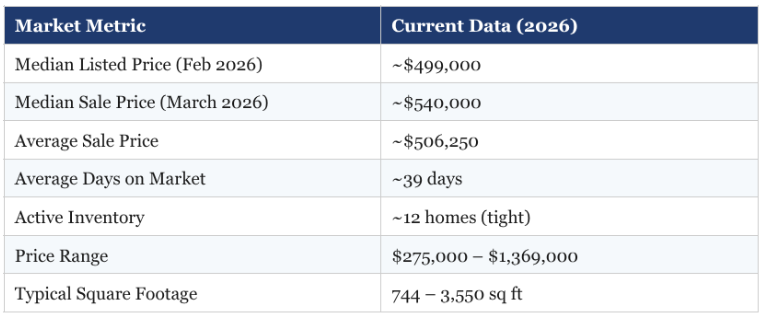
What the data tells you: Riverdale Park is a more competitive market than neighboring Hyattsville. With only around 12 active listings at any given time, inventory is genuinely tight. Homes are selling after roughly 39 days on market — faster than Hyattsville's current 49-day average — and the gap between listed and sold prices suggests buyers are still paying close to asking on desirable properties.
The price range is wide because the housing stock is varied. On the lower end, you'll find bungalows and cape cods that need updating — good opportunities for buyers who want to renovate and build equity. On the upper end, fully renovated craftsman homes, larger colonials, and newer townhomes at Riverdale Park Station trade well above the median. Some of the most historically significant homes on Oliver Street — including an 1898 restoration that has been meticulously preserved — represent the premium tier of this market.
How Riverdale Park Compares to Nearby Communities
Hyattsville: $80,000–$140,000 lower median prices, but carries the dual city+county tax burden. Different trade-off.
University Park (adjacent, to the west): Substantially higher — typically $650,000–$900,000+ for comparable homes. The most expensive unincorporated community in PG County.
College Park: Comparable prices, stronger new construction presence, more University of Maryland-influenced buyer pool.
Takoma Park (MoCo): $150,000–$200,000 higher on average, similar community character.
DC (Brookland/Hyattsville border communities): $200,000–$350,000 higher for equivalent square footage.
The value proposition is real: Riverdale Park offers a community with authentic urban fabric, a functioning town center, MARC rail access, and two Purple Line stations on the way — for less than DC, less than Montgomery County, and at a lower effective tax rate than Hyattsville.
Property Taxes in Riverdale Park: What You Actually Pay
This is one of Riverdale Park's most underappreciated advantages over Hyattsville, and it's something every buyer comparing the two communities should understand clearly.
Riverdale Park is an incorporated town, but unlike Hyattsville, it does not levy a substantial separate municipal property tax on top of the Prince George's County rate. Your primary tax obligation is the PG County property tax.
The tax advantage relative to Hyattsville is real but modest — roughly $1,500–$2,000 per year on a comparable home. For many buyers, this is not the deciding factor. But it is a genuine difference, and when combined with Riverdale Park's higher price points reflecting more development investment and stronger infrastructure, the total cost picture is more nuanced than the raw purchase price suggests.
The Purple Line: Why Riverdale Park Has Two Stations and Why That Matters
Most neighborhoods along the Route 1 corridor will benefit from the Purple Line's opening. Riverdale Park is in a category by itself: it has two stations within town limits — the Riverdale Park station near Kenilworth Avenue and a second station at the east end of the corridor — making it one of the most Purple Line-accessible communities on the entire 16-mile alignment.
The current construction status is significant. As of March 2026, the Purple Line is approximately 90% complete. At the Riverdale Park–Kenilworth station specifically, sidewalks, stairs, and elevator towers are already in place — you can walk up to the station structure and get a clear picture of what it will look like when it opens. The project is now in its final phases: station finishing, bridge completion, and systems testing. The current opening target is late 2027.
Purple Line construction is actively affecting the Riverdale Park area right now. As of April 2026, crews are implementing pedestrian detours along Riverdale Road between Auburn Avenue and the Baltimore-Washington Parkway for final sidewalk reconstruction, and intersection work continues at Kenilworth Avenue. If you are buying in Riverdale Park today, you are buying into active construction disruption — but you are also buying 12–18 months before a major transit asset opens. That sequencing has historically rewarded buyers who get in before ribbon-cutting.
What the Purple Line Means for Riverdale Park Buyers
When the Purple Line opens, Riverdale Park residents will be able to travel east-west across the Maryland suburbs — from New Carrollton to Bethesda — without a car and without routing through downtown DC. For a resident commuting to the NIH campus in Bethesda, the University of Maryland campus in College Park, or the federal complex at New Carrollton, this is a material quality-of-life upgrade. For buyers evaluating long-term appreciation potential, the transit opening is the single most important near-term catalyst in this market.
Getting Around: MARC Rail, Bus, and Metro Access
Riverdale Park's transit story does not begin and end with the Purple Line. The town already has excellent transit infrastructure by Maryland suburban standards.
MARC Rail — Riverdale Park Station (Camden Line)
The Riverdale Park MARC station is one of the most walkable transit assets in the Route 1 corridor. Residents in the central part of town can reach it on foot or by a short bike ride, and the trail connection through the town center makes it genuinely car-free accessible. MARC's Camden Line runs from Union Station in downtown DC north to Baltimore — making this station particularly valuable for federal employees and contractors who work at or near Union Station, Capitol Hill, or points along the line toward Baltimore.
MARC does not operate on weekends or federal holidays, which is a limitation worth knowing. But for the five-day-a-week commuter, it is one of the most efficient transit options in the county.
Metro Access
The nearest Green/Yellow Line Metro stations are the College Park-UMD station to the north and the West Hyattsville station to the south, both accessible via bus connections from Riverdale Park. Direct walking distance to either is approximately 1.5–2 miles. Bus service along Route 1 links to both stations, and PG County's TheBus service — which became free for all riders in mid-2025 — provides additional options.
Driving
Route 1 is the main north-south artery, and the Baltimore-Washington Parkway runs along the eastern edge of town — providing quick access to the Beltway, BWI Airport, and Annapolis. For buyers who do drive, the neighborhood's inside-the-Beltway position and Parkway access make it practical for commutes in most directions.
Flood Risk in Riverdale Park: What Every Buyer Must Know
Flood risk is one of the most important hyperlocal issues in Riverdale Park, and I want to be direct about it because it varies significantly street by street.
Riverdale Park sits on relatively flat terrain adjacent to the Northeast Branch of the Anacostia River system and Queensbury Run, a tributary creek that runs through portions of the town. Some blocks in Riverdale Park carry meaningful flood risk — enough that the town government maintains a dedicated flood resources page and has hosted community meetings with Prince George's County specifically on stormwater management and FEMA flood maps.
Flooding concerns have also factored into local development debates. In 2024, Riverdale Park's mayor cited flooding as a concern in discussions about a proposed development near the Purple Line station, noting that large impervious surface areas could worsen an already challenging stormwater situation for nearby residents.
What to Do Before You Make an Offer in Riverdale Park
1. Look up the specific address on FEMA's Flood Map Service Center (msc.fema.gov)
2. Ask your agent whether the property has a history of flooding or is in a FEMA-designated Special Flood Hazard Area (SFHA)
3. If the property is in a flood zone, get a flood insurance quote before committing — it can add $1,000–$3,000+ per year to your ownership costs
4. Ask about the elevation certificate if one exists for the property
5. Walk the block during or immediately after a heavy rain if possible
Not all of Riverdale Park has elevated flood risk — many streets are fine. The issue is specific to lower-lying areas near the creek corridors. Know before you buy.
Schools in Riverdale Park
Riverdale Park falls within Prince George's County Public Schools. As with most of urban Prince George's County, school quality is mixed, and buyers with school-age children should research individual school ratings and PGCPS magnet program options carefully rather than relying on general county-level assessments.
One notable asset for families in Riverdale Park is the College Park Academy, a public charter school housed within Riverdale Park Station itself — a 50,107 square foot building that serves as an anchor educational institution within the mixed-use town center. Discussions are ongoing to add a gymnasium or arts facility to the space. The academy's presence within walking distance of the town center is a meaningful advantage for families who qualify for enrollment.
Private school options within reasonable driving distance include DeMatha Catholic High School in Hyattsville and a range of options in Montgomery County and DC proper. I always recommend that buyers with school-age children contact PGCPS directly about boundaries and magnet options specific to their address before finalizing a purchase.
Who Lives in Riverdale Park?
Riverdale Park attracts a particular kind of buyer — one who values authenticity, neighborhood identity, and urban form but isn't willing to pay DC prices for it. The community is diverse, engaged, and vocal. Local civic participation is high: residents show up to town council meetings, weigh in on development decisions, and actively shape what the neighborhood becomes. This is not a neighborhood of passive homeowners.
The community is built around a few distinct buyer profiles:
University of Maryland-affiliated buyers — faculty, researchers, administrators, and graduate students who want walkable proximity to campus without paying College Park or Takoma Park prices
Federal employees and contractors who value the MARC line into Union Station and proximity to the major federal employment clusters
Buyers relocating from genuinely urban environments — New York, Chicago, Boston — who need a neighborhood that translates, not just a suburb with a coffee shop
Renovation buyers and first-time buyers who want to get into a high-quality neighborhood with upside
Long-term investors and move-up buyers who understand the Purple Line story and want to be positioned ahead of the opening
The neighborhood's founding as a streetcar suburb in 1902 created a physical layout — front porches, connected streets, mixed uses along the main corridor, a civic commons — that still defines how people interact with each other here. That urban DNA is not something you can replicate in a newer development. It's one of the genuine assets of the community.
What Daily Life Looks Like in Riverdale Park
For day-to-day errands, Riverdale Park Station handles almost everything: Whole Foods for groceries, restaurants for dining, the farmers market for local produce, and a growing retail mix for other needs. Most residents who live within a 10-minute walk of the town center find they genuinely use their car far less than they expected.
The Northwest Branch Trail runs through or adjacent to the town and connects to a broader regional trail network — a significant asset for runners, cyclists, and families. The trail also connects directly to the MARC station, making car-free commute access genuinely practical for physically active residents.
Riverdale Park's events calendar has grown significantly alongside the town center's development. Bear Square, the central gathering space at Riverdale Park Station, hosts markets, community events, and seasonal programming that gives the neighborhood a sense of shared civic life that most suburban communities never achieve.
The miXt food hall at Riverdale Park Station, while it has seen tenant turnover since opening, continues to evolve — with newer concepts like the forthcoming Kusshi restaurant adding to the dining options available without leaving the town center area. Call Your Mother Deli, which opened in early 2025, has been a particular hit with residents and has added to the neighborhood's culinary identity.
What to Watch For When Buying in Riverdale Park
Flood risk by address: As covered above, this is non-negotiable. Know the FEMA flood designation before you make an offer. I can help you evaluate this for any specific property.
Purple Line construction disruption: Active construction impacts are ongoing through at least spring 2026, with detours and lane closures near Kenilworth Avenue and Riverdale Road. If you're buying near the station areas, budget mentally for a transitional period before the amenity is fully operational.
Tight inventory: With roughly 12 active listings at any given time, Riverdale Park is a market where you need to be financially ready to move quickly on the right property. Pre-approval is not optional here — it's the baseline. Having an agent who knows when properties are coming to market before they hit Zillow is a meaningful advantage.
Housing age and condition: Like Hyattsville, the core housing stock is 80–120 years old. Craftsmanship is often excellent, but older systems are common. Never waive your inspection contingency. Foundation issues, older electrical panels, and lead paint are all possibilities in this price range and vintage.
Development pipeline: Additional multifamily units are approved and expected at Riverdale Park Station — 600 units beyond the initial 349. This is mostly a positive signal (more residents supporting more retail), but buyers should understand that the neighborhood's density and character will continue evolving over the next several years.
Frequently Asked Questions About Riverdale Park, MD
Is Riverdale Park a good place to buy a home in 2026?
Yes — particularly for buyers who understand the Purple Line timeline and want to be positioned ahead of the opening. The neighborhood has a functioning town center, genuine transit infrastructure, authentic housing stock, and home prices that are below comparable DC-area communities with similar walkability. The active construction disruption is real but temporary. The transit and lifestyle upside is permanent.
What is the average home price in Riverdale Park?
As of early 2026, median listed prices are approximately $499,000, and median sale prices for single-family homes are running around $540,000. The range is wide — from the mid-$200,000s for properties needing significant work to over $1 million for the best-renovated historic homes. Average days on market is approximately 39 days.
How does Riverdale Park compare to Hyattsville for home buyers?
Riverdale Park generally carries higher purchase prices than Hyattsville but a lower effective property tax rate, since Hyattsville has a dual city-plus-county tax structure that Riverdale Park does not. Riverdale Park also has two dedicated Purple Line stations to Hyattsville's none, and the Riverdale Park Station town center is a more developed commercial anchor than what Hyattsville currently offers. For buyers who can afford the slightly higher price point, Riverdale Park often represents better long-term value.
What transit options serve Riverdale Park?
Current transit options include the Riverdale Park MARC station (Camden Line) with walkable access to downtown DC and Baltimore, bus connections to the Green/Yellow Line Metro at College Park and West Hyattsville, and Route 1 bus service. The Purple Line — currently approximately 90% complete with two stations in town limits — is expected to open in late 2027, adding direct light rail service connecting Bethesda, Silver Spring, College Park, and New Carrollton.
Does Riverdale Park have a flood risk problem?
Parts of Riverdale Park do have meaningful flood risk, particularly in lower-lying areas near Queensbury Run and the Northeast Branch of the Anacostia River. The risk varies significantly by address. Every buyer should look up the specific property on FEMA's flood map and ask their agent about flood history for any home they're seriously considering. This is not a blanket disqualifier for the neighborhood — many streets are not in designated flood zones — but it is something you must verify at the address level.
What is Riverdale Park Station?
Riverdale Park Station is a 36-acre transit-oriented, mixed-use development that serves as the town's commercial and civic center. It includes Prince George's County's first and only Whole Foods Market, multiple restaurants (Burton's Grill, Call Your Mother Deli, Horu Sushi, and others), a craft brewery, retail, a 120-room hotel, 349 residential units with 600 more approved, and Bear Square — a public gathering space for markets and events. It was developed by Cafritz Enterprises and is now managed by First Washington Realty, which acquired the retail portion in March 2025.
How many Purple Line stations does Riverdale Park have?
Two. The Riverdale Park–Kenilworth station and a second station at the eastern end of the corridor, both within town limits. As of March 2026, both stations are visibly taking shape with sidewalks, stairs, and elevator towers in place. The Purple Line is currently approximately 90% complete overall and is expected to open in late 2027.
Thinking About Buying in Riverdale Park?
I specialize in the Route 1 corridor — Riverdale Park, Hyattsville, College Park, and the surrounding Prince George's County communities.
Riverdale Park is one of my most active markets. I know which streets have flood history, which blocks are positioned best relative to the Purple Line stations, and when properties are coming to market before they hit the national sites. If you're serious about buying here, that knowledge is the difference between a great outcome and a frustrating one.
I offer free, no-obligation consultations for buyers at any stage of the process.
Call or Text any Time: 443-990-1230
Email: Ryan.Hehman@compass.com
Or reach out directly through the contact page — I respond quickly and I won't hand you off to an assistant.