

Living in Edmonston, MD: A Complete Neighborhood Guide for Home Buyers (2026)
Most buyers searching for homes on the Route 1 corridor have never heard of Edmonston. While buyers compete for listings in Hyattsville, Riverdale Park, and College Park, Edmonston sits between them — less than three miles from Washington, DC, bordering the Hyattsville Arts District to the west — with roughly 300 homes, median property taxes among the lowest of any incorporated town in this part of Prince George's County, and a community identity so distinct that the EPA Administrator showed up for the groundbreaking of its main street renovation in 2009. This is the most underappreciated neighborhood on the Route 1 corridor, and for the right buyer, it may be the best-kept secret in the entire DC metro area.
Edmonston is genuinely small — 0.37 square miles, approximately 1,600 residents, fewer than a dozen home sales in a typical year. It is not for buyers who want a busy real estate market or abundant listing inventory. But for buyers who are willing to wait for the right property, who value authenticity over amenity density, and who want the lowest-cost entry point on the Route 1 corridor without sacrificing the corridor's community character, Edmonston deserves serious attention.
Where is Edmonston?
Edmonston is an incorporated town in Prince George's County, situated along the Northeast Branch of the Anacostia River between Hyattsville to the west and Bladensburg to the east, with Riverdale Park to the north. Its ZIP code is 20781 — the same as Hyattsville's — and the two communities are so closely intertwined that many regional real estate listings describe Edmonston properties as being in Hyattsville. This is both a practical reality for buyers and a source of mild frustration for Edmonston's fiercely independent residents, who incorporated the town in 1924 precisely to establish an identity separate from Hyattsville.
The town's founding story is worth knowing. The land that would become Edmonston was first settled after the Civil War by Adam Francis Plummer and his wife Emily Saunders Arnold Plummer — a man who had been enslaved on the Riversdale Plantation in present-day Riverdale Park and who, after emancipation, purchased ten acres of land and worked to reunite family members who had been sold to plantations across the South. He named his settlement Mt. Rose, after his favorite plant. The community that grew around his land was later platted as two subdivisions in 1903 — East Hyattsville and Palestine — and formally incorporated as Edmonston in 1924. That founding story, rooted in resilience, self-determination, and community-building in the face of extraordinary adversity, is not incidental to what Edmonston is today. It is the foundation.
The town covers 0.37 square miles — slightly smaller than Edmonston's neighbor to the west, and tiny even by Route 1 corridor standards. Its approximately 300 homes are laid out along a small grid of streets anchored by Decatur Street, the main residential corridor that crosses the Northeast Branch of the Anacostia River and gives the town its tagline: 'A Bridging Community.' The housing stock is primarily early-20th-century Craftsman bungalows and Cape Cod cottages, most built between 1903 and the 1940s, on small lots with the same pre-car street proportions that define the best of the Route 1 corridor's historic neighborhoods.
Edmonston is part of the Gateway Arts District along with Hyattsville, Mount Rainier, and Brentwood — though it is the smallest and least commercially developed of the four communities. It is not a destination neighborhood in the way Hyattsville's arts corridor is. It is a residential community that happens to sit inside one of the most interesting and rapidly evolving urban corridors in the DC metro area, with access to all of the Gateway Arts District's amenities a short walk or bike ride away.
America's Green Town: The Sustainability Identity That Sets Edmonston Apart
Edmonston's defining community project — the one that earned it national attention, an EPA Administrator's presence at the groundbreaking ceremony, and coverage from CNN to the Washington Post — is the Decatur Street Green Street project. And understanding it is essential to understanding what makes this town different from every other small community on the Route 1 corridor.
The backstory: between 2003 and 2006, Edmonston experienced a series of devastating floods. In one particularly bad year, 56 homes were underwater along Decatur Street, which crosses the Anacostia River's Northeast Branch at the heart of the town. The town's mayor at the time, Adam Ortiz — who later became Prince George's County's Director of the Environment — led a community effort that turned a stormwater crisis into something genuinely remarkable.
Instead of fixing the failed street infrastructure the conventional way, Edmonston rebuilt Decatur Street as the first Green Street in Maryland — and, at the time of its completion in November 2010, arguably on the entire East Coast. The project, funded through more than $1 million in grants, transformed the street using seven integrated sustainability principles:
LED streetlights replacing conventional lighting
A green power purchase agreement covering the street's electricity use
Elevated crosswalks for pedestrian safety and traffic calming
Bump-out rain gardens that capture and filter stormwater runoff
Permeable pavement bike lanes that allow water to infiltrate rather than run off
Native plantings — magnolias and red maples — replacing invasive species
Widened sidewalks improving pedestrian access throughout
The completed project captures almost all stormwater runoff from the street, preventing it from entering the Anacostia River as polluted runoff. It has won multiple awards from the American Society of Landscape Architects and the Chesapeake Stormwater Network, and has inspired similar green street projects in communities across the country. When the EPA Administrator attends your street renovation ceremony, you know you've built something that matters.
But the Green Street is only the most visible piece of Edmonston's sustainability infrastructure. The town also has one of the highest rates of residential solar panel adoption, rain barrel use, and native plant landscaping of any community its size in the DC area. Electric vehicles and a charging station sit at town hall. The town composts leaf litter collected from residents, with the composting handled by ECO City Farms. New residents receive a welcome bag full of information on sustainable living, local environmental groups, and how to participate in solar purchasing cooperatives.
City Administrator Rod Barnes has described it plainly: 'We're as green a community as you can probably find anywhere.' For a town with a staff of three people and an annual budget of $1.2 million, the depth of the sustainability commitment is extraordinary.
ECO City Farms
The anchor of Edmonston's sustainability community is ECO City Farms — a certified naturally grown urban teaching farm and nonprofit located at 4913 Crittenden Street in Edmonston, with a second farm at 6100 Emerson Street in Bladensburg. ECO City Farms cultivates over 75 varieties of vegetables, herbs, and fruit across approximately 1.3 acres in Edmonston, distributing produce through CSA shares, farmers markets, and wholesale partnerships, and accepting SNAP/EBT and other food assistance programs.
Beyond the food production, ECO City Farms runs youth education programs, a Beginning Farmer Training program for adults who want to learn urban agriculture, volunteer workdays, and cooking classes taught in an on-farm kitchen housed in a shipping container. The farm's community garden adjacent to the growing area offers plots distributed by lottery to Edmonston and surrounding residents. It is a place where residents literally grow their own food a mile from Washington, DC — which remains remarkable no matter how many times you say it.
The town also hosts an annual Green Fair and Pet Fest in July, celebrates Bike to Work Day in May, and holds the monthly Forklift First Friday event at Community Forklift — a nearby reuse warehouse that sells donated furniture, appliances, and home décor and turns into a community gathering space with local bands, food trucks, and craft beer one Friday evening per month.
Edmonston Real Estate: What to Expect in 2026
Edmonston is the most thinly traded real estate market on the Route 1 corridor. Fewer than a dozen homes sell in the town in a typical year, and active inventory at any given moment may be as few as one or two properties. This is both a challenge and an opportunity: buyers who are patient and positioned to move quickly when the right property appears can access price points that simply do not exist in the neighboring communities.
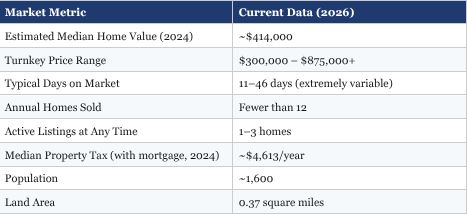
The price range is wide for such a small market, which reflects significant variation in property condition. On the lower end, you will find older Craftsman bungalows and Cape Cods that need updating — properties priced to reflect their as-is condition, often in the low-to-mid $300,000s. On the upper end, fully renovated homes, newer construction on infill lots, and larger properties trade at $600,000-$875,000+. Most buyers in Edmonston are looking in the $380,000-$500,000 range for a solid, livable home with some updating still to do.
The single most important thing to understand about buying in Edmonston: this is not a market where you browse Zillow and schedule a tour next weekend. Properties in good condition sell quickly when they appear — some in 11 days or fewer — and the pool of available homes at any given time is genuinely tiny. Buyers who are serious about Edmonston need to be pre-approved, know exactly what they're looking for, and have a local agent who can alert them to properties before or as they hit the market.
The Property Tax Advantage
This is Edmonston's most underappreciated financial advantage, and it is significant. The median property tax paid in Edmonston in 2024 was approximately $4,613 per year for homeowners with a mortgage — lower than Hyattsville (which carries a dual city-plus-county burden of $7,600-$8,000 on a comparable home), and competitive with Riverdale Park and College Park. Edmonston is an incorporated town, so buyers do pay both county and municipal taxes, but the town's municipal rate is modest and the overall combined burden is among the most favorable on the Route 1 corridor.
The effective tax rate of approximately 1.1% of assessed value, combined with home values that are genuinely lower than the neighboring arts district communities, means that monthly ownership costs in Edmonston can be meaningfully lower than in Hyattsville or Mount Rainier for comparable-sized homes.
How Edmonston Compares to Route 1 Corridor Neighbors
vs. Hyattsville Arts District: Edmonston runs $50,000-$100,000 lower on median prices with a significantly lower effective tax burden. Hyattsville has far more commercial amenity density and walkable restaurants. Edmonston has quiet residential streets and direct access to the Northeast Branch trail system.
vs. Riverdale Park: Riverdale Park runs $80,000-$130,000 higher median prices. Riverdale Park has the Whole Foods town center and two Purple Line stations. Edmonston has lower entry costs, lower taxes, and the same trail access — but far fewer amenities within the town itself.
vs. Bladensburg (adjacent, to the east): Similar price points and community scale, but Edmonston has the Green Street identity, ECO City Farms, and the more established community character.
vs. Brentwood (adjacent to the northwest): Very similar price range and community size. Brentwood has slightly more commercial presence along Rhode Island Avenue. Edmonston has the sustainability identity and the trail access.
Flood Risk in Edmonston: What Every Buyer Must Know
Flood risk is the most important due-diligence issue in Edmonston, and I want to address it directly and honestly rather than burying it in a footnote. The town's location straddling the Northeast Branch of the Anacostia River means that parts of Edmonston carry real, documented flood risk — not theoretical risk, but actual flood history that shaped the entire identity of the community.
Between 2003 and 2006, Edmonston suffered repeated severe flooding events. In the worst year, 56 homes in the town were underwater. This crisis prompted the $6 million Archimedes' screw flood pumping station — a technology rarely deployed at this scale in the United States, which uses three massive screw-pump mechanisms to lift and discharge stormwater out of the Anacostia watershed — and the Green Street project that redirected and filtered stormwater at the street level.
The infrastructure investment has materially reduced the flood risk for many properties in the town. The stormwater pumping station is operational and the green street infrastructure is actively managing runoff. But the Northeast Branch still runs through the heart of the town, and properties in lower-lying areas adjacent to the river corridor carry FEMA-designated flood risk that no amount of infrastructure fully eliminates.
Flood Due Diligence Checklist for Edmonston Buyers
1. Check the specific address on FEMA's Flood Map Service Center (msc.fema.gov) before making any offer
2. Ask whether the property is in a FEMA Special Flood Hazard Area (SFHA) — if so, flood insurance is required by lenders
3. Ask the seller or listing agent directly: has this property flooded since 2005?
4. Get a flood insurance quote before committing — it can add $1,500–$4,000+/year to ownership costs on affected properties
5. Request an elevation certificate if one exists for the property
6. Ask the town directly about the stormwater infrastructure improvements and which streets are best protected
Not every property in Edmonston carries elevated flood risk. Many of the town's streets are well above the floodplain. The risk is real but highly address-specific.
I can help you evaluate flood risk for any specific property in Edmonston before you make an offer.
The town's aggressive response to its flood history — the pumping station, the green street, the ongoing stormwater management investment — is itself a marker of community seriousness that distinguishes Edmonston from other at-risk communities that have done less. But buyers must do address-level due diligence regardless. This is non-negotiable.
Getting Around: Transit Access from Edmonston
Edmonston does not have a Metro station or a MARC rail station within the town, but transit access is better than its size would suggest, and the Purple Line will improve the picture further when it opens.
Bus Transit
Prince George's County's TheBus routes along Route 1 (to the west of Edmonston) connect residents to the College Park-UMD Metro station on the Green Line, approximately three miles away. PG County TheBus service became free for all riders in mid-2025. Metrobus routes along nearby Kenilworth Avenue and Rhode Island Avenue provide additional connections to both the Green/Yellow and Red Line Metro systems. From the College Park Metro station, downtown DC is approximately 25 minutes by rail.
Riverdale Park MARC Station — Walkable Access
The Riverdale Park MARC station on the Camden Line is approximately one mile north of Edmonston's center — walkable for active commuters and bikeable for most residents. The Northeast Branch Trail, which runs directly through Edmonston, connects to Riverdale Park Station via a trail link, making the station genuinely car-free accessible for residents willing to make the mile-long walk or bike ride. MARC's Camden Line runs into Union Station in downtown DC and north to Baltimore, making this a practical option for federal workers and contractors commuting along that corridor.
The Purple Line: Improving Edmonston's Transit Picture
The Purple Line light rail, currently approximately 90% complete and scheduled to open in Winter 2027, will run along the Kenilworth Avenue/Riverdale Road corridor immediately adjacent to Edmonston's eastern edge. While the closest Purple Line stations are in Riverdale Park (Riverdale Park-Kenilworth station) and slightly further north or south, Edmonston residents will be within practical biking distance of Purple Line service — meaningfully improving east-west transit connectivity across the Maryland suburbs. For buyers evaluating long-term transit access, the Purple Line is a genuine upside for Edmonston, even if the closest stations are technically outside town limits.
Driving
Kenilworth Avenue (MD-201) runs along Edmonston's eastern edge and provides direct access to the Baltimore-Washington Parkway, the Beltway, and downtown DC via New York Avenue. Route 1 (Baltimore Avenue) runs along the western edge. For buyers who commute by car, the town's position between these two major arterials — with the Beltway accessible in minutes — is a genuine advantage. The tradeoff is that both corridors carry heavy traffic during peak hours.
The Northeast Branch Trail
The Northeast Branch Trail is a 4-mile paved path that follows the Anacostia River's Northeast Branch directly through Edmonston, connecting north to Riverdale Park and south toward the Anacostia watershed trail network. For residents who bike or run, this trail is one of Edmonston's most underappreciated assets — it provides car-free recreational access and connects to the broader regional trail system that extends toward DC. The trail runs through the heart of the town and is accessible from most residential streets.
Schools in Edmonston
Edmonston falls within Prince George's County Public Schools, and the schools serving the town have the mixed performance profile typical of urban PG County communities. Buyers with school-age children should research school assignments at the specific address level and explore PGCPS magnet program options.
The College Park Academy, a STEM-focused public charter school associated with the University of Maryland and located at Riverdale Park Station, serves students in grades 6-12 and is accessible to families throughout the corridor. It is a competitive enrollment process but worth researching for families who align with its mission. DeMatha Catholic High School in Hyattsville is the most prominent private option within the immediate area.
As with all Route 1 corridor communities, the proximity to Washington, DC also places Edmonston families within reach of DC's own school choice landscape, including the DC Public Charter School system, which is relevant for families with DC-adjacent circumstances.
Who Lives in Edmonston?
Edmonston is one of the most genuinely diverse small towns in the DC metro area — and the diversity is not demographic background noise but a lived, integrated reality of the community. The town is approximately 47% Hispanic, 36% Black or African American, and 11% White, with nearly 59% of residents speaking a language other than English at home and 55% speaking Spanish as a primary home language. The median age is 32.3 years. The median household income is approximately $78,000-$82,000.
This is a working community. Many residents are essential workers, service workers, construction trades, and government employees. The poverty rate is approximately 7.8% — not negligible, but lower than many inner-Beltway communities of similar demographics. The homeownership rate reflects a mix of long-term owner-occupants and renters who have lived in the town for years or decades.
The town's history of electing diverse leadership — including Kinjiro Matsudaira, the grandson of a Japanese feudal lord, who was elected mayor of Edmonston in 1927 (and re-elected in 1943, during World War II, in a deliberate act of community solidarity) — reflects a pluralism that runs through the community's entire 100-year incorporated history. That tradition of independent, principled community governance continues today.
Buyers who choose Edmonston tend to be one of two profiles: either long-term community members or new arrivals who specifically sought out a small, values-driven community at the lower end of the Route 1 corridor price spectrum. The sustainability-minded buyer — someone who cares about walkability, trail access, urban agriculture, and environmental stewardship — finds a genuine home here in a way that is hard to manufacture in a newer, larger community. So does the buyer who simply wants to be close to DC and the corridor's amenities at the lowest possible cost.
What Daily Life Looks Like in Edmonston
Daily life in Edmonston requires honest expectations about amenity density. The town itself has very few commercial businesses — Three Brothers Italian Restaurant is the most-cited local spot for pizza by the slice, and there are a handful of other small businesses along Kenilworth Avenue. The town is fundamentally residential, and most daily errands happen in neighboring Hyattsville, Riverdale Park, or Bladensburg rather than in Edmonston itself.
What the town does have, in abundance, is the community infrastructure that makes small-town living genuinely rewarding. The Northeast Branch Trail runs through the heart of the community. The ECO City Farm offers residents a direct connection to local food production, volunteer opportunities, and community programs. The community garden gives residents their own growing plots. The town's annual Green Fair and Pet Fest, Bike to Work Day participation, and the monthly Forklift First Friday events create a rhythm of community engagement that larger towns rarely achieve.
Everything the Gateway Arts District offers — Franklin's and Busboys and Poets in Hyattsville, Vigilante Coffee, Whole Foods at Riverdale Park Station, the Hyattsville Arts Festival, Joe's Movement Emporium in Mount Rainier — is within a short bike ride or drive from Edmonston. Residents who live in Edmonston essentially enjoy proximity to all of those amenities without paying the Hyattsville or Riverdale Park price premium.
The Anacostia River Park within the town limits provides a playground, basketball court, and baseball diamond alongside the river. The Northeast Branch Trail, accessible directly from most residential streets, provides the most significant outdoor amenity — and the kayak access points along the Anacostia River watershed give water-sports-minded residents an unusual urban outdoor option.
What to Watch For When Buying in Edmonston
Flood risk by address: As covered in detail above, this is the most consequential due-diligence issue in Edmonston. Do not skip the FEMA flood map check. Do not assume the town's infrastructure improvements have eliminated risk for every property. Verify at the specific address level. I can help with this.
Thin inventory — be ready to move: With fewer than a dozen sales per year, the Edmonston market is not one you can browse casually. When a good property appears, buyers who are pre-approved and decisive have an enormous advantage over those who are still researching. If you're seriously considering Edmonston, get your financing in order before you need it.
Shared ZIP code creates search confusion: Edmonston's ZIP code (20781) is shared with parts of Hyattsville. National real estate portals often list Edmonston properties as Hyattsville, and some Hyattsville properties appear in Edmonston searches. Be specific when searching by address and verify the actual town with the listing agent or county records.
Limited commercial amenities within town: There are very few businesses in Edmonston itself. If you need to walk to a coffee shop, a grocery store, or a restaurant within the town limits, Edmonston is not the right community. All of those amenities exist a short distance away in neighboring communities, but you will need to drive or bike to reach them. Buyers who are car-dependent or prefer dense urban amenity within walking distance should look at Hyattsville or Riverdale Park instead.
Home age and condition: The housing stock is primarily early-20th-century construction. Craftsman bungalows and Cape Cods built between 1903 and the 1940s are common. These homes have character and often good bones, but they carry the same age-related risks as the Mount Rainier historic district: older electrical systems, original plumbing, lead paint, and foundation issues are all possibilities. Always get a thorough inspection and never waive the contingency.
The Purple Line proximity: The Kenilworth Avenue corridor running along Edmonston's eastern edge is an active Purple Line construction zone through 2026. Buyers near Kenilworth Avenue should understand what that means for noise and disruption in the near term, and what the transit connectivity upside looks like once the line opens in Winter 2027.
Frequently Asked Questions About Edmonston, MD
Is Edmonston a good place to buy a home in 2026?
Yes — for the right buyer. Edmonston offers the lowest entry price point on the Route 1 corridor inside the Beltway, a moderate property tax burden, trail access, proximity to all of the Gateway Arts District's amenities, and a genuinely distinctive community identity built around sustainability, diversity, and civic engagement. The trade-offs are real: thin inventory, limited amenities within town, flood risk that requires careful due diligence, and older housing stock. Buyers who know what they're getting and are financially prepared to act quickly will find real value here.
What are home prices like in Edmonston?
Edmonston is the most affordable incorporated town on the Route 1 corridor. Turnkey homes start around $300,000 for a two-bedroom and reach $875,000+ for larger, fully updated properties. The median estimated home value is approximately $414,000 based on 2024 data. The market is extremely thin — fewer than 12 sales per year — so monthly statistics are volatile. Days on market range from under two weeks for desirable properties to over a month for others.
How bad is flooding in Edmonston?
Edmonston experienced serious, repeated flooding between 2003 and 2006 — in the worst year, 56 homes were underwater. The town responded with a $6 million state-of-the-art stormwater pumping station using Archimedes' screw technology, and the nationally recognized Green Street project on Decatur Street that captures and filters runoff. These infrastructure investments have materially reduced risk for many properties. However, flood risk remains real for properties in lower-lying areas near the Northeast Branch of the Anacostia River. Every buyer must check the FEMA flood map for the specific address before making an offer.
What is the Green Street in Edmonston?
The Edmonston Green Street is a 2010 transformation of Decatur Street — the town's main residential corridor — into the first green street in Maryland. Built using over $1 million in grants, it features LED streetlights, permeable pavement bike lanes, rain garden bump-outs, elevated pedestrian crossings, native plantings, and a green power purchase agreement. The project captures almost all stormwater runoff from the street, preventing it from entering the Anacostia River as pollution. It received national media coverage, an EPA Administrator's presence at its groundbreaking, and has influenced green street designs across the country.
What is ECO City Farms?
ECO City Farms is a certified naturally grown urban teaching farm and nonprofit located at 4913 Crittenden Street in Edmonston (with a second farm in Bladensburg). It cultivates over 75 varieties of vegetables, herbs, and fruit on approximately 1.3 acres, selling produce through CSA shares, farmers markets, and wholesale, and accepting SNAP/EBT and other food assistance. ECO City Farms also runs youth education programs, a Beginning Farmer Training program for adults, volunteer workdays, and cooking classes in an on-farm kitchen. It is one of the defining community institutions of Edmonston and a model for urban agricultural nonprofits regionally.
How do I commute from Edmonston?
Edmonston does not have a Metro station, but transit options include TheBus connections to the College Park-UMD Metro station (Green Line, approximately three miles away), bikeable access to the Riverdale Park MARC station (Camden Line, approximately one mile north via the Northeast Branch Trail), and Metrobus routes on nearby Kenilworth Avenue and Route 1. By car, Kenilworth Avenue provides quick access to the Baltimore-Washington Parkway and the Beltway. The Purple Line, expected to open in Winter 2027, will add light rail service with a station at the Kenilworth Avenue/Riverdale Road corridor immediately adjacent to Edmonston, improving east-west transit connectivity significantly.
What makes Edmonston different from Hyattsville or Riverdale Park?
Three things primarily: scale, price, and character. Edmonston is tiny — 0.37 square miles, approximately 300 homes, fewer than 12 sales per year — which creates a small-town intimacy that Hyattsville and Riverdale Park, both larger and more commercially developed, cannot replicate. Prices are meaningfully lower than either neighbor. And the sustainability identity — the Green Street, ECO City Farms, the solar and rain barrel culture, the nationally recognized environmental programming — gives Edmonston a community purpose that is entirely its own. Buyers who choose Edmonston are not settling for the cheapest option on the corridor. They are choosing a specific kind of community.
Ready to Start Your Home Search?
I'm a real estate agent with Compass who specializes in the Route 1 corridor — Edmonston, Hyattsville, Riverdale Park, College Park, Mount Rainier, and the surrounding Prince George's County communities.
I offer free, no-obligation consultations for buyers at any stage.
Call or Text: 443-990-1230
Email: Ryan.Hehman@compass.com
Or reach out directly through the contact page — I respond quickly and won't hand you off to an assistant.
Related articles:
Living in the Hyattsville Arts District: A Complete Neighborhood Guide for Home Buyers (2026)
Living in Riverdale Park, MD: A Complete Neighborhood Guide for Home Buyers (2026)
Living in Mount Rainier, MD: A Complete Neighborhood Guide for Home Buyers (2026)
Living in College Park, MD: A Complete Neighborhood Guide for Home Buyers (2026)
DC vs. Maryland Suburbs: Where Should You Actually Live When Relocating to the DC Area?