

Living in College Park, MD: A Complete Neighborhood Guide for Home Buyers (2026)
College Park is not what most buyers expect when they first start looking here. They come in thinking 'college town' — which conjures images of student rentals, pizza shops, and bar noise on Route 1 — and what they find instead is a genuinely diverse city of 17 distinct neighborhoods, world-class trail access, a Metro station with direct service to downtown DC, and one of the most significant university-driven economic development initiatives in the country actively reshaping the area around it. The buyers who figure this out early, and who know which neighborhoods within College Park actually work for homeowners, are the ones who get the value. The ones who dismiss it as a student town miss a real opportunity.
As of early 2026, median home prices in College Park range from approximately $436,000 to $462,000 depending on source and property type — roughly comparable to Hyattsville and Riverdale Park, but with a completely different neighborhood mix, more single-family inventory, and a growth story driven by a $2 billion university development initiative and five Purple Line stations either on or adjacent to campus. This is one of the most interesting buying opportunities on the Route 1 corridor right now.
Where Is College Park, MD?
College Park is an incorporated city in Prince George's County, approximately eight miles northeast of downtown Washington, DC. It is best known as the home of the University of Maryland — a flagship public research university with over 40,000 students and thousands of faculty and staff — but the city is considerably more than a campus town. It encompasses roughly 17 named neighborhoods ranging from walkable urban blocks adjacent to campus to quiet, almost entirely owner-occupied residential communities with tree-lined streets and mid-century homes.
The city runs along both sides of Route 1 (Baltimore Avenue) and extends west to the Paint Branch Creek corridor and east toward the Baltimore-Washington Parkway. Its northern edge runs into Beltsville and the Beltway (I-495), and its southern border touches Riverdale Park and University Park. The College Park-UMD Metro station on the Green Line sits at the southern end of the city, providing direct rail access to downtown DC.
What makes College Park genuinely interesting for buyers right now is the scale of investment flowing into it. The Greater College Park initiative — a $2 billion public-private partnership between the University of Maryland, Prince George's County, the State of Maryland, and private developers — is actively transforming the Route 1 corridor and the Discovery District research park adjacent to the Metro station. Over two million square feet of development projects are currently underway or completed. The Purple Line will add five stations on or near campus when it opens in Winter 2027. These are not future hypotheticals — the construction is visible and progressing.
College Park's Neighborhoods: Which Area Is Right for You?
This is the most important question for any buyer in College Park, because the answer varies enormously depending on what you're looking for. The city has 17 distinct neighborhoods and the character differences between them are significant. Here is a practical breakdown of the key areas:
Old Town College Park
Old Town is the neighborhood immediately adjacent to the University of Maryland campus — walkable to the main gate, dense with student rentals and off-campus housing, and home to most of the fraternity and sorority houses. This is College Park's most walkable neighborhood and the closest to campus by foot, but it also carries the trade-offs of proximity to a major university: street noise, parking pressure, and some properties in need of maintenance. For buyers, Old Town is primarily interesting as an investment rental play — strong and consistent demand from UMD students and staff. For owner-occupants who are not affiliated with UMD, it is generally not the right fit.
Calvert Hills
Calvert Hills is College Park's premium owner-occupant neighborhood — large lots, mature tree canopy, well-maintained homes, and a strong sense of community. It sits just north of the campus main gate and attracts faculty families, professionals, and long-term residents who value space and stability. Properties in Calvert Hills routinely trade at the upper end of the College Park range, often approaching or exceeding $550,000 for well-maintained single-family homes. If your priority is a quiet, owner-occupied neighborhood close to campus with real architectural character, this is the target.
Berwyn
Berwyn is one of College Park's most consistently recommended neighborhoods for families and non-student buyers. It sits south of the campus along Rhode Island Avenue, has a weekly farmers market, strong neighborhood associations, and a tight-knit community identity. Berwyn residents tend to be a mix of UMD faculty, federal employees (several major federal agencies are nearby), and long-term homeowners who specifically chose it for the community feel. It's walkable in the neighborhood sense — trails, parks, neighbors on front porches — though you'll want a car for most errands. Properties here are generally more affordable than Calvert Hills while offering the same owner-occupant stability.
Hollywood
Hollywood is College Park's largest neighborhood, located in the northern part of the city south of I-495 and close to the Greenbelt Metro and MARC stations. It's predominantly single-family homes — ramblers, colonials, and split-levels from the 1950s — and is one of the more affordable entry points in the city. For buyers who want a quiet suburban feel, proximity to the Greenbelt Metro, and starter-home pricing, Hollywood is worth a serious look. MOMS Organic Market and The Board and Brew (a bike shop and café that doubles as a community gathering spot) anchor the Hollywood Plaza commercial node.
College Park Estates / Yarrow
This is College Park's upscale suburban pocket — 100% single-family homes, 91% owner-occupied, attractive yards, and larger lot sizes than most of the city. It has a quieter, more classically suburban feel than Calvert Hills or Berwyn. Buyers here typically prioritize space and homeownership stability over walkability to campus.
North College Park (Cherry Hill, Sunnyside, Daniels Park, Branchville)
North College Park encompasses several sub-neighborhoods north of Greenbelt Road, just inside or just outside the Beltway. These are some of the most affordable areas within the College Park city limits — small two-to-four bedroom ramblers and split-levels from the 1950s, primarily owner-occupied, with relatively low traffic and a genuine starter-home character. As David Alecia, president of the North College Park Community Association, has described it: 'They're affordable, small — two to four bedrooms, built in the '50s. They're old but cute. And it's some of the most affordable real estate in the Beltway area.' Future Purple Line station access adds long-term upside to some of these blocks.
College Park Real Estate: What to Expect in 2026
Here is the current market picture for College Park as of early 2026:
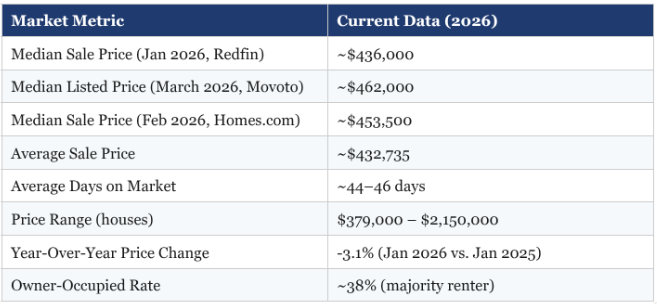
What the data tells you: College Park is currently a buyer's market. Prices are modestly down from last year, homes are sitting on the market for 44-46 days, and sellers have less leverage than during the peak years of 2021-2023. The 38% owner-occupancy rate is important context — this is a city where the majority of housing is rented, driven heavily by student demand. But for buyers specifically targeting the owner-occupant neighborhoods (Calvert Hills, Berwyn, College Park Estates, Hollywood), you are operating in a much tighter sub-market than the city-wide number suggests.
One important note on price range: College Park's housing market runs from entry-level ramblers in North College Park at $380,000-$420,000 all the way to premium Calvert Hills homes at $550,000-$700,000+. The $436,000 median masks significant variation by neighborhood. Knowing where within College Park you're buying is more important here than in most markets on the corridor.
College Park vs. the Route 1 Corridor
vs. Hyattsville: Comparable median prices, but College Park has a city tax (see below) that is modestly lower than Hyattsville's. More single-family inventory in College Park; more walkable urban character in Hyattsville.
vs. Riverdale Park: Riverdale Park's median is roughly $60,000–$80,000 higher. Riverdale Park has more developed town center amenities (Whole Foods) and two Purple Line stations; College Park has the Metro, more diverse neighborhood options, and the UMD economic engine.
vs. University Park: University Park (adjacent to College Park's western border) is substantially more expensive — typically $650,000–$900,000+. Many buyers who want College Park's access but can't reach University Park's prices end up specifically in Calvert Hills as the logical alternative.
vs. Greenbelt: Comparable or slightly higher prices in College Park, more neighborhood diversity, stronger long-term appreciation case due to university investment.
Property Taxes in College Park: The Full Picture
College Park, like Hyattsville, is an incorporated city within Prince George's County — which means you pay both county and city property taxes. This is different from unincorporated communities like Mount Rainier or parts of Riverdale Park, where you only pay the county rate.
However, College Park's city tax structure has an important nuance that makes it more affordable than Hyattsville's: the city provides a 'tax differential' that partially offsets the city rate for property owners within city limits, accounting for services the city provides that would otherwise be covered by the county. The net effect is a city tax burden that is meaningful but more moderate than Hyattsville's.
College Park Property Tax Estimate (2026)
Prince George's County rate: ~1.19% of assessed value
City of College Park rate: ~30.18 cents per $100 assessed value (residential, FY2024 rate)
Note: City collects a tax differential that partially offsets the county rate for city residents
On a $450,000 home (approximate):
County portion: ~$5,355/year
City portion: ~$1,358/year (before differential credit)
Combined estimate: ~$6,000–$7,000/year depending on differential
Compare to Hyattsville: ~$7,600–$8,000/year on a comparable home
Compare to Riverdale Park: ~$6,200–$6,500/year on a comparable home
Always verify the current rate and differential with the City of College Park and Prince George's County before closing. Rates are set annually.
The bottom line: College Park's effective tax burden sits between Riverdale Park (lower) and Hyattsville (higher). It is a real cost that factors into your monthly payment, but it is more moderate than Hyattsville's dual-tax structure and is partially offset by the city services and infrastructure investment that come with it.
Getting Around: Metro, MARC, Purple Line, and the UMD Shuttle Network
College Park's transit infrastructure is the strongest on the Route 1 corridor — and it is about to get significantly better.
College Park-UMD Metro Station (Green Line)
The College Park-UMD Metro station at the southern end of the city is the anchor of the transit network. The Green Line provides direct service to downtown DC — L'Enfant Plaza, Gallery Place, and Union Station are all 25-35 minutes away with no transfers. For buyers who commute to the federal employment core, the Metro is a genuine daily asset. The station also offers a fully secure Bike & Ride facility, making it practical for cyclists who want to combine biking and transit.
The station connects to the Shuttle-UM network, which provides free service around the UMD campus and to several surrounding neighborhoods. For residents affiliated with the university, this essentially provides car-free access between their neighborhood, the Metro station, and every part of campus.
MARC Rail (Camden Line) — Greenbelt Station
The Greenbelt MARC station, accessible from the southern and eastern neighborhoods of College Park, provides commuter rail service into Union Station and Baltimore. For buyers in the Hollywood, North College Park, or College Park Estates areas who work along the MARC Camden corridor, this is a meaningful transit option.
The Purple Line: Five Stations on or Near Campus
This is the transit story that makes College Park genuinely remarkable for buyers looking 12-24 months ahead. When the Purple Line opens in Winter 2027, it will serve five stations on or adjacent to the UMD campus: Adelphi Road/West Campus, Campus Drive, Baltimore Avenue/UMD, College Park Metro, and Riverdale Park North. No other community on the entire 16-mile alignment has this level of Purple Line coverage.
The practical impact is enormous. UMD students, faculty, and staff will be able to ride fare-free between those five stops. Residents living near any of the campus-area stations will gain direct east-west light rail access connecting College Park to Silver Spring, Bethesda, Takoma/Langley Park, and New Carrollton — all without routing through downtown DC. For buyers at the College Park Metro station who currently transfer at Gallery Place to reach Bethesda on the Red Line, the Purple Line will eventually provide a direct one-seat connection.
Where is construction right now? As of late 2025, Purple Line track installation on Campus Drive, Rossborough Lane, Presidential Drive, and the Route 1/Rossborough intersection were all complete. The platforms, windscreens, and canopies of the Baltimore Avenue-UMD station were installed. Light-rail vehicle testing began near the College Park Metro station in November 2025 and on campus in early 2026 — overnight runs that are increasingly visible to residents. The project is approximately 90% complete overall and remains on track for a Winter 2027 opening.
Driving and the Beltway
For buyers who drive, College Park's position at the intersection of Route 1 and the Beltway (I-495) makes it practical for commutes in almost any direction. The Baltimore-Washington Parkway runs along the eastern edge of the city. BWI Airport is approximately 20 miles north. For buyers with jobs in suburban Maryland office parks or who need Beltway access regularly, College Park is genuinely well-positioned.
The University of Maryland Economic Engine: Why It Matters for Home Buyers
Most buyers evaluate College Park as a real estate market without fully understanding the economic force driving it. The University of Maryland is not just a college campus — it is the anchor of what is becoming one of the most significant public-private research and development corridors on the East Coast.
The Greater College Park initiative is a $2 billion public-private partnership that is actively reshaping the Route 1 corridor. At its core is the Discovery District — a 150-acre research park on 2 million square feet of development adjacent to the College Park Metro station, built as a partnership between UMD and Corporate Office Properties Trust (COPT). The Discovery District houses start-up companies, major technology clients, four federal agencies, and most recently, a Microsoft quantum research laboratory — announced by Governor Wes Moore in September 2024 — that positions College Park at the center of a growing quantum computing cluster.
What does this mean for home buyers? Several things. First, it means a steady and growing base of high-income, educated residents who are neither students nor transient — faculty, researchers, federal employees, and tech workers who buy homes and stay. Second, it means ongoing public investment in the infrastructure around campus: the $29 million Baltimore Avenue corridor upgrade (new median, bike lanes, widened sidewalks, improved lighting along the 1.4-mile Route 1 stretch) was completed in 2024. Third, it means long-term appreciation pressure from institutional investment that most suburban markets simply don't have.
Buyers who understand this buy in Calvert Hills, Berwyn, or near the campus corridor and hold. Buyers who don't understand it see 'college town' and move on. The gap between those two perspectives is where the opportunity lives.
Schools in College Park
College Park falls within Prince George's County Public Schools, and school quality is genuinely mixed — consistent with most urban PG County communities. Buyers with school-age children should research specific school assignments for any address they're considering, as ratings vary significantly across the city's neighborhoods.
There are several assets worth knowing about. The College Park Academy is a well-regarded public charter school associated with the University of Maryland that serves students in grades 6-12 with a STEM-focused curriculum. It is located at Riverdale Park Station and serves a broader geographic area than standard PGCPS schools — competitive enrollment but worth researching for families in the corridor.
The University of Maryland's presence also means that many families in College Park have access to UMD enrichment programs, camps, and facilities that effectively supplement the public school experience. For buyers whose children are UMD-affiliated (through a parent's employment), additional resources are available.
For buyers who prioritize top-rated public schools as a primary criterion, College Park requires careful research at the address level. Do not assume that proximity to a great university translates directly to high-performing elementary schools in every neighborhood — they are different institutions serving different populations.
What Daily Life Looks Like in College Park
College Park's lifestyle experience varies significantly by neighborhood — which is part of why the neighborhood-level analysis earlier in this post matters so much. Here is the broader picture:
Green space access is exceptional. Lake Artemesia Natural Area, a 38-acre lake and natural area in the Berwyn Heights/College Park boundary area, hosts free summer concerts and is a community gathering point. Greenbelt Park — a 1,100-acre National Park Service property — is accessible from North College Park. Paint Branch Golf Complex offers a 9-hole course and driving range near the eastern edge of the city. The Indian Creek trail and the trail network connecting to Riverdale Park Station and beyond gives residents meaningful car-free recreational access.
The restaurant and retail scene is evolving rapidly. The downtown College Park corridor along Route 1 has improved significantly over the past several years as part of the Greater College Park investment — new restaurants, cafés, and retail that were not there five years ago are now there. MOMS Organic Market anchors Hollywood Plaza. The College Park Farmers Market brings a weekly community gathering point to the Berwyn area. The Board and Brew functions as a neighborhood living room for the North College Park community.
For buyers affiliated with UMD, the university's cultural and athletic programming — concerts, lectures, Terrapins games at SECU Stadium and Xfinity Center, film screenings, and museum events — effectively extends the lifestyle amenity set available without leaving the area. For buyers with no university affiliation, these are still accessible and add to the texture of living here.
The city has 17 active civic associations, which is a meaningful indicator of community engagement. College Park neighborhoods are not passive — residents organize, advocate, and show up. For buyers who value civic life and neighborhood identity, this is a feature, not background noise.
What to Watch For When Buying in College Park
The renter-heavy nature of the market: College Park is roughly 62% renter-occupied city-wide, driven by student demand. This affects the character of some blocks meaningfully. When evaluating a specific property, look closely at the surrounding block — the percentage of owner-occupied homes on that street matters more than city-wide statistics for predicting what your daily neighborhood experience will actually be like.
Noise and traffic near campus: The blocks immediately adjacent to the UMD campus boundary, particularly in Old Town, experience noise levels and parking pressures that owner-occupants often find frustrating. Blocks that are walkable to campus but not on the immediate perimeter tend to offer a much better daily experience.
Purple Line construction disruption: Active construction impacts continue along Baltimore Avenue through 2026 near the campus corridor. The Baltimore Avenue/UMD station area has seen the most intensive work. If you're buying near the alignment, understand the current construction timeline before committing.
Investment rental competition: Because student demand is strong and consistent, College Park attracts investor buyers who convert single-family homes to student rentals. In some neighborhoods this affects property maintenance and block character. Again: walk the block, not just the house.
The city tax differential: Work with an agent or the city directly to understand exactly how the tax differential affects your specific property's net tax burden. The gross rate is ~30 cents per $100, but the differential credit varies and can meaningfully change the effective rate.
Upside concentration near Purple Line stations: Not all College Park neighborhoods benefit equally from the Purple Line. Properties within reasonable walking distance of the five campus-area stations — particularly in the Calvert Hills, Berwyn, and campus-adjacent areas — are best positioned to capture transit-driven appreciation. Properties in North College Park closer to the Beltway are further from the Purple Line alignment.
Frequently Asked Questions About College Park, MD
Is College Park a good place to buy a home in 2026?
Yes — with neighborhood-level nuance. The city as a whole is a buyer's market with modestly falling prices and growing inventory. But within that, the owner-occupant neighborhoods (Calvert Hills, Berwyn, College Park Estates, Hollywood) are tighter and more competitive than the city-wide numbers suggest. For buyers who understand the neighborhood geography and the $2 billion Greater College Park investment driving long-term appreciation, College Park offers real value right now.
What is the average home price in College Park?
As of early 2026, median sale prices are running approximately $436,000–$453,000 depending on source, with median listed prices around $462,000. The range is wide — from $379,000 for entry-level ramblers in North College Park to $700,000+ for premium Calvert Hills homes. Average days on market is approximately 44-46 days.
Which College Park neighborhood is best for families?
Calvert Hills and Berwyn are the two neighborhoods most consistently recommended for owner-occupant families. Calvert Hills offers large lots, mature trees, architectural character, and proximity to campus at the upper end of College Park pricing. Berwyn offers strong community identity, a weekly farmers market, and slightly more affordable prices. College Park Estates and Yarrow are good options for buyers who want more space and a quieter, more suburban feel. For families who prioritize affordability and are comfortable with older housing stock, North College Park's Hollywood neighborhood is worth serious consideration.
How does the Purple Line affect buying in College Park?
Significantly. College Park will have five Purple Line stations on or adjacent to the UMD campus when the line opens in Winter 2027 — more than any other single community on the 16-mile alignment. This creates direct east-west light rail connectivity to Silver Spring, Bethesda, Takoma/Langley Park, and New Carrollton. Properties within walking distance of campus-area stations are best positioned to capture the transit premium that typically builds as an opening date approaches. Light rail vehicle testing is currently underway on campus; the project is approximately 90% complete as of early 2026.
Does College Park have a city property tax?
Yes. College Park is an incorporated city within Prince George's County, so property owners pay both the county rate (~1.19% of assessed value) and a city rate of approximately 30 cents per $100 of assessed value. However, the city provides a 'tax differential' credit that partially offsets the county rate for city residents, making the effective total burden more moderate than Hyattsville's dual-tax structure. On a typical College Park home, expect a combined annual tax bill in the $6,000–$7,000 range, though this varies by assessed value and the specific differential calculation.
Is College Park safe?
Safety varies by neighborhood, as it does in any city of College Park's density and mix. Calvert Hills, Berwyn, College Park Estates, and Hollywood are generally considered safe, stable neighborhoods with active civic associations and high owner-occupancy rates. The blocks immediately surrounding the UMD campus experience the kinds of incidents typical of dense college-town environments. I always recommend that buyers walk any specific block they're considering, at different times of day, and look at the neighborhood-level (not city-level) crime data before making a decision.
What is the Greater College Park initiative?
Greater College Park is a $2 billion public-private partnership between the University of Maryland, Prince George's County, the State of Maryland, and private developers. It encompasses the Discovery District research park (two million square feet on 150 acres adjacent to the Metro station), a revitalized downtown College Park corridor along Route 1, new hotel and retail development, and coordinated investment in transportation and public infrastructure. Recent milestones include a Microsoft quantum computing research laboratory choosing the Discovery District and the completion of a major $29 million Baltimore Avenue corridor upgrade. The initiative positions College Park as a long-term economic growth node, not just a campus town.
Ready to Find Your Neighborhood in College Park?
I'm specialize in helping people buy and sell along the Route 1 corridor — College Park, Riverdale Park, Hyattsville, and the surrounding Prince George's County communities.
College Park's neighborhood geography is special. I know which blocks have the owner-occupant character you're looking for, which Purple Line station areas are best positioned for appreciation, and how the tax differential calculation works on specific addresses. If you're seriously considering College Park, let's talk before you start touring.
I always offer free, no-obligation consultations for buyers at any stage of the process.
Email: Ryan.Hehman@compass.com
Direct: 443-990-1230
Or reach out directly through the contact page — I respond quickly and won't hand you off to an assistant.
Related articles:
Living in the Hyattsville Arts District: A Complete Neighborhood Guide for Home Buyers (2026)
Living in Riverdale Park, MD: A Complete Neighborhood Guide for Home Buyers (2026)
DC vs. Maryland Suburbs: Where Should You Actually Live When Relocating to the DC Area?
Is 2026 a Good Time to Buy a Home in DC or Maryland? What the Data Actually Says