

Selling an Inherited or Estate Home in Prince George's County, MD
A Family Guide to Probate, Trusts, Personal Representatives, and Getting the Property Sold | 2026
If you're reading this, you're probably navigating one of the most emotionally and logistically complicated things a family can face: figuring out what to do with a home that belonged to someone you love.
Maybe a parent just passed away and you've been named the personal representative of the estate. Maybe you're the adult child of someone who can no longer live independently and the family needs to sell the house to fund their care. Maybe there's a will, or maybe there isn't. Maybe there's a trust you didn't know about. Maybe there are siblings involved and not everyone agrees. Maybe the house hasn't been touched in twenty years and you have no idea what it's worth or what it will take to sell it.
All of that is normal. And all of it is manageable — with the right information and the right people in your corner.
This guide covers the full picture for families in Prince George's County, Maryland: how probate works here, what happens when a home is held in a trust, what you need to know if your parent is heading to assisted living or a nursing home, how taxes on an inherited home actually work (most families owe far less than they expect), and what a real estate sale looks like when the property is an estate home in as-is condition. These are the conversations I have with PG County families regularly — in Hyattsville, Riverdale Park, College Park, Bowie, Laurel, and everywhere in between.
The Two Most Common Situations: Probate vs. Assisted Living
Scenario 1: A Loved One Has Passed — Now What?
When a homeowner in Prince George's County passes away, the first question families face is: who has the legal authority to sell the property? The answer depends entirely on how the property was titled and whether a will or trust was in place.
There are three common paths:
Formal Probate: The home was titled solely in the deceased's name, with no surviving joint owner and no trust. The estate must go through the Register of Wills and the Orphans' Court in Upper Marlboro before the property can be sold.
Trust Administration: The property was held in a revocable living trust. The successor trustee can sell the home without court involvement, often much faster.
Joint Tenancy / Right of Survivorship: The property was jointly owned with survivorship rights. The surviving owner automatically inherits and can sell immediately.
Scenario 2: An Aging Parent is Moving to Assisted Living
This scenario is more complicated than most families expect, and the timing of a home sale can have major financial consequences. If your parent may need Medicaid to cover nursing home or memory care costs in the future, how and when you sell the home matters enormously — more on that below.
The good news: as long as the homeowner is living and mentally competent, they can sell their own home. If cognitive decline or incapacity is a factor, you'll need either a durable power of attorney or a court-appointed guardian to act on their behalf.
The PG County Probate Process: A Real Estate Timeline
Probate in Prince George's County is handled through the Register of Wills office at the Prince George's County Courthouse, 14735 Main Street, Room D4001, Upper Marlboro, MD 20773. As of 2024, the office operates by appointment only — call ahead before visiting.
Here is how the timeline typically unfolds for a home sale:
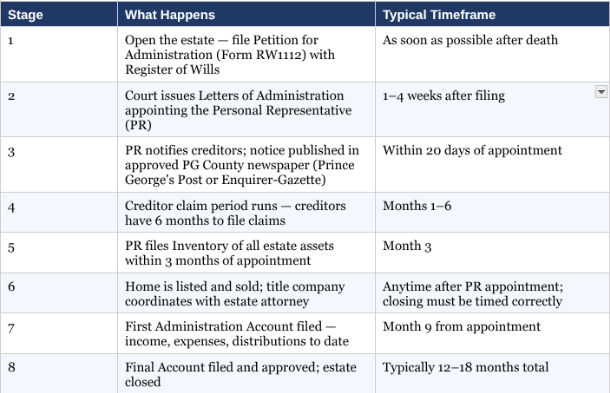
Important: Can the Home Be Sold Before Probate Is Complete?
Yes — in most cases. The Personal Representative can list and sell the home at any time after receiving Letters of Administration. However, the sale proceeds go into the estate account and cannot be distributed to heirs until the estate is formally closed. This is one of the most misunderstood aspects of probate real estate in PG County. A good real estate agent who understands probate can help coordinate closing with your attorney to avoid delays.
Small Estates: The Simplified Path
If the total estate value (all assets) is $50,000 or less — or $100,000 if the surviving spouse is the sole heir — the family can file a Small Estate Petition (Form RW1103) for a significantly faster process. Many PG County homes will exceed this threshold, but personal property estates where the home is jointly titled may qualify.
Probate Fees in Prince George's County
Maryland probate filing fees are based on the estate's total value. Here is the general fee schedule:
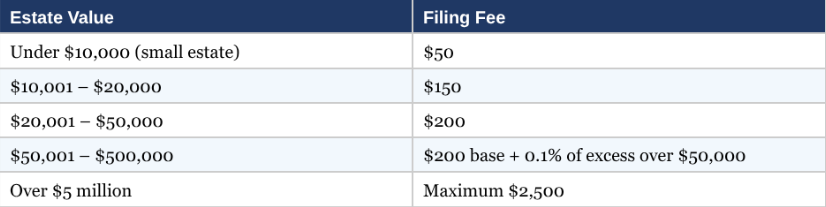
Publication costs in an approved newspaper typically add $50–$100. Attorney fees, if hired, are separate and usually range from 2%–4% of the estate value for a routine estate.
Selling a Home Held in a Trust in Maryland
Many families in Prince George's County discover after a parent passes that the home was held in a revocable living trust. This is actually good news: trust-held property does not go through probate at all, which means the successor trustee can sell the home much more quickly — often within 30–60 days of appointment.
The trustee's authority to sell comes from the trust document itself, not from the Orphans' Court. Here is what the process typically looks like:
The successor trustee gathers the trust document and any amendments
The trustee obtains a death certificate and provides it to the title company
The home is listed and sold; the title company reviews the trust to confirm authority to convey title
Proceeds are distributed to beneficiaries according to the trust terms — no court approval needed for routine distributions
Watch Out: Trust Problems That Can Delay a Sale
Not all trusts are clean. Common issues I see in Prince George's County: (1) The property was never formally transferred into the trust — the deed still shows the owner's personal name. This creates a partial probate situation. (2) The trust document is ambiguous about the trustee's authority to sell real estate. (3) Multiple co-trustees must agree but are not communicating. An experienced probate real estate agent will identify these issues early and help you work with your attorney before they become delays at the closing table.
Assisted Living, Nursing Homes, and the Home: What Families Must Know
The Medicaid Question Everyone Is Afraid to Ask
One of the most common situations I help families navigate is this: Mom or Dad is moving to a memory care facility or nursing home, and the family needs to know whether to sell the house now, hold onto it, or do something else entirely.
The stakes are high. If your parent ever needs Medicaid to cover long-term care costs in Maryland, the home sale — and its timing — can affect their Medicaid eligibility. Here is what you need to understand:
The 5-Year Lookback Period
Medicaid has a 60-month (5-year) lookback period. When someone applies for Medicaid long-term care (nursing home Medicaid), Maryland reviews all financial transactions from the prior five years. If assets — including a home — were transferred for less than fair market value during that window, Medicaid can impose a penalty period of ineligibility.
What this means practically:
Selling a parent's home at fair market value is fine — the proceeds must be spent down or placed in exempt categories
Gifting the home, or selling it to a family member below market value, within 5 years of a Medicaid application can trigger a penalty
If your parent may need Medicaid within 5 years, consult an elder law attorney before selling or transferring the home
Maryland Medicaid Estate Recovery
Maryland participates in the federal Medicaid Estate Recovery Program (MERP). This means that after a Medicaid recipient dies, Maryland can seek reimbursement from the estate for care costs paid. For most families, the home is the estate's main asset.
However, recovery is deferred if any of the following apply:
A surviving spouse is still living
A surviving child under age 21, or a blind or disabled child, is living in the home
A dependent family member lived in the home at the time of death and for at least 2 continuous years before
Maryland also allows hardship waivers in certain circumstances — for example, if the home's value is modest relative to county averages. If you are facing a Medicaid estate recovery claim on a Prince George's County home, consult an elder law attorney before signing anything.
When Should You Sell the Home vs. Hold It?
Sell before assisted living if: the owner is mentally competent, Medicaid is not needed, and the family wants to avoid property maintenance costs and carrying costs on a vacant home.
Consider holding if: the 5-year lookback window is recent, Medicaid may be needed, or the home is still being used as a primary residence by a qualifying family member.
The right answer depends on your specific family situation. This is not a one-size-fits-all decision — which is exactly why working with a local real estate agent who understands these issues is so valuable.
Taxes When You Sell an Inherited Home in Maryland
Tax anxiety is one of the biggest reasons families delay selling. Most families in Prince George's County are pleasantly surprised by what they actually owe. Here is how the numbers work:
The Stepped-Up Basis Rule: Your Family's Biggest Tax Break
When you inherit a home, the IRS resets your cost basis to the home's fair market value on the date of death. This is called a stepped-up basis. It is one of the most valuable provisions in the tax code for heirs.
Here is a real-world example from Prince George's County:
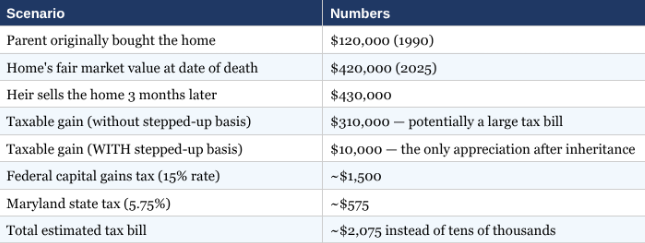
The stepped-up basis applies automatically — you do not need to file any special form to claim it. You will need an appraisal or documentation of the home's fair market value as of the date of death.
Maryland Inheritance Tax
Maryland is one of only six states with a state inheritance tax. The good news: lineal heirs — parents, children, grandchildren, and spouses — pay 0%. Collateral heirs (nieces, nephews, friends) pay 10% on assets received. For most PG County families selling a parent's home, Maryland inheritance tax is not owed.
Maryland Estate Tax
Maryland has an estate tax that applies to estates exceeding $5 million in total value. For most families in Prince George's County, this threshold is not reached and estate tax is not a factor.
Maryland Transfer Tax at Closing
When the home is sold, the estate pays Maryland's 0.5% state transfer tax on the sale price, plus Prince George's County's recordation tax. These closing costs are standard and are paid from sale proceeds, not out of pocket.
Selling the Home: Practical Guidance for PG County Families
Do All Heirs Have to Agree to Sell?
This question comes up constantly. Here is the honest answer:
With a Personal Representative (probate): The PR has the legal authority to sell the property to pay estate debts and costs, even without unanimous heir consent. However, heirs must be notified, and disputes can be brought to the Orphans' Court.
With a Trust: The trustee has authority under the trust document. If multiple co-trustees are appointed, the trust will specify whether they must act unanimously or by majority.
Multiple heirs who inherited property outright: All heirs must agree to sell. If one refuses, the others can petition the court for a partition action — but this is slow and expensive. Getting everyone aligned early saves enormous stress.
Selling As-Is: Common for Estate Properties
Estate homes in Prince George's County are almost always sold in as-is condition, and that is completely acceptable to buyers — as long as the price reflects the property's condition. Here is what families need to know:
As-is does not mean skipping the disclosure: The Personal Representative or trustee must complete a Maryland Residential Property Disclosure or file a Disclaimer Statement. An experienced agent will guide you through this.
Deferred maintenance affects price, not eligibility to sell: Many estate homes in Hyattsville, Riverdale Park, and College Park have not been updated in 20–30 years. This affects market value but does not prevent a sale.
Vacant homes have carrying costs: Property taxes, utilities, lawn maintenance, and insurance add up quickly. Families often underestimate the cost of delay.
Estate properties attract investors and renovators: This is a feature, not a bug. Marketing the property appropriately reaches buyers who are comfortable with as-is condition and do not require extensive repairs.
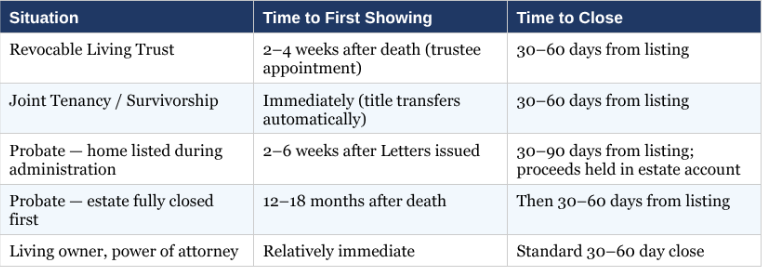
Timeline: How Long Does the Entire Process Take?
Frequently Asked Questions: Probate and Estate Home Sales in Prince George's County
How long does probate take in Prince George's County before I can sell the house?
You can often list the home within weeks of probate opening — once the Personal Representative has Letters of Administration, they have legal authority to sell. The full probate process typically takes 12–18 months to close, but the home sale itself can happen much earlier. Sale proceeds go into the estate account until the estate is formally settled.
Can the personal representative sell a house without all heirs agreeing?
Yes, in most circumstances. The PR has a fiduciary duty to the estate, which includes selling property to pay debts and distribute assets. However, heirs must be notified and have the right to object through the Orphans' Court. In practice, communicating clearly with all heirs and getting general alignment makes the process smoother and avoids court delays.
Do I pay capital gains tax when I sell an inherited house in Prince George's County?
Almost certainly very little. The stepped-up basis rule resets your cost basis to the home's fair market value at the date of death. Families who sell shortly after inheriting typically owe capital gains only on the small amount of appreciation that occurred after the date of death. Lineal heirs (children, grandchildren) also owe zero Maryland inheritance tax on the home.
Can Medicaid take my parent's house if they go into a nursing home in Maryland?
Medicaid cannot force a sale while your parent is living in the home or while a qualifying spouse, child, or dependent lives there. However, Maryland participates in the Medicaid Estate Recovery Program, which means the state can seek reimbursement from the estate after death. If your parent may need Medicaid soon, speak with an elder law attorney before selling or transferring the property — timing and structure matter significantly.
Can I sell an estate house as-is in Maryland?
Yes. Estate properties are routinely sold as-is in Prince George's County. The Personal Representative must still complete the Maryland disclosure forms (or file a disclaimer), but no repairs are required. Pricing the home to reflect condition is key — the PG County market includes active buyers who specifically seek estate and fixer-upper properties, particularly along the Route 1 corridor and in older neighborhoods like Hyattsville and College Park.
What if there are multiple heirs who disagree on selling?
This is one of the most common — and most stressful — situations I help families through. If a PR or trustee has clear authority, the sale can proceed. If heirs inherited the property outright with no governing document, any co-owner can petition for partition — which forces a court-ordered sale. The better path is almost always facilitated communication before it reaches that point. I have helped families work through disagreements to reach a sale that works for everyone.
Working with a Local Agent Who Understands Estate and Probate Sales
Selling an estate home in Prince George's County is not like selling an ordinary listing. The paperwork is different, the timeline is different, and the consequences of a misstep — like accepting the wrong offer structure or failing to properly disclose as-is condition — can create legal headaches for the estate.
I have worked with families across Hyattsville, Riverdale Park, College Park, Bowie, and Laurel navigating exactly these situations. I understand how to coordinate with estate attorneys, title companies that handle probate transactions, and buyers who are comfortable purchasing estate properties. I can also give you a current market valuation of the property — something the estate will need for court filings and pricing decisions.
Ready to Talk? Here's What I Offer Families in This Situation:
A free, no-obligation market valuation of the estate property
Guidance on timing — when to list relative to the probate or trust timeline
Coordination with your attorney and title company at no additional charge
A clear-eyed, honest assessment of the home's condition and what price to expect
Ryan Hehman | Compass
Serving Prince George's County, Montgomery County, and DC
Email: Ryan.Hehman@compass.com
Phone (Call or Text): 443-990-1230
There is no rush and no pressure. I know these situations are emotionally and logistically overwhelming. My job is to make the real estate piece as simple as possible so your family can focus on what matters most.
Disclaimer
This article is for informational purposes only and does not constitute legal, tax, or financial advice. Probate law, Medicaid rules, and tax regulations are complex and change frequently. Always consult a qualified Maryland attorney and/or tax professional for guidance specific to your situation. Real estate agent Ryan Hehman is licensed in Maryland and is not an attorney or tax advisor.