

Why UMD Parents Are Buying Condos and Homes in College Park and Hyattsville — Instead of Paying for Room and Board
Here's a question more UMD parents are asking in 2026: Why am I paying $17,000 a year for my kid to live in a dorm when I could own a property near campus, have roommates help cover the mortgage, and potentially sell it four years later for a profit? The answer, increasingly, is: you shouldn't be. Parents of University of Maryland students — both undergrad and graduate — are discovering that buying a condo or single-family home near campus in College Park or Hyattsville can be a smarter financial move than paying room and board. In the right scenario, you build equity, generate rental income from roommates, and unlock meaningful tax advantages that a dorm fee receipt will never give you.
Room and Board at UMD: What Are You Actually Paying?
Let's start with the baseline. For the 2025–2026 academic year, on-campus housing at the University of Maryland costs approximately $5,037 per semester for the room alone, plus $3,336 for the meal plan — totaling roughly $8,373 per semester, or $17,106 for the full academic year. Over four years, that's over $68,000 flowing directly into the university's pocket, with zero return on that investment.
Graduate students living on or near campus face similar costs, and the lack of mandatory dining plans doesn't make it dramatically cheaper when off-campus apartment rents near College Park and Hyattsville have climbed steadily.
The Real Math:
4 years × $17,106 = $68,424 in room & board payments
Equity built from dorm fees: $0
Tax deductions from paying room & board: $0
Return when your student graduates: $0
The Alternative: Buy a Property, Let Roommates Help Pay the Mortgage
Here's what I'm seeing work really well for families right now. A parent purchases a 3- or 4-bedroom condo or single-family home near the University of Maryland. Their student occupies one bedroom. The remaining rooms are rented to their student's friends or classmates at fair market rates — typically $700–$1,000 per room per month in College Park and Hyattsville.
On a property purchased in the $250,000–$350,000 range (which is very achievable in Hyattsville and parts of College Park right now), 2–3 roommates paying rent can cover a substantial portion — sometimes the majority — of your monthly mortgage payment. Your actual out-of-pocket cost can end up comparable to, or even less than, what you'd spend on room and board.
But unlike room and board, at the end of four years, you still own the asset.
Buying vs. Room & Board: A Side-by-Side Comparison
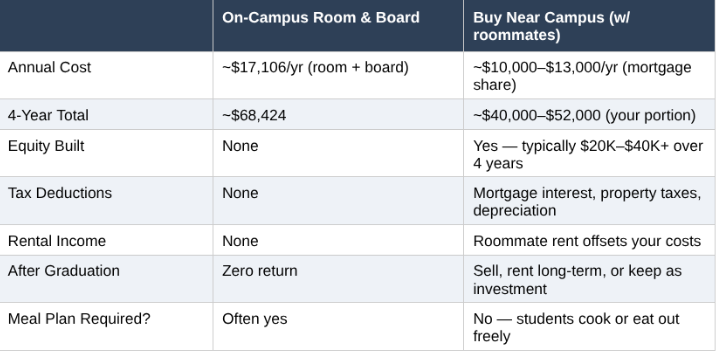
The numbers above are illustrative and will vary based on purchase price, down payment, mortgage rate, and how many roommates share the property. But the directional advantage of ownership is consistent: you are building something, rather than spending money with no return.
The Tax Advantages of Buying Near UMD
This is where owning near campus gets really interesting — and where parents who consult a CPA before buying can unlock significant additional savings. Here's a breakdown of the main tax benefits:
1. Mortgage Interest Deduction
If you purchase the property as a second home and use it personally (or your dependent child uses it), you can deduct mortgage interest just as you would on your primary residence. Married couples filing jointly can deduct interest on up to $750,000 of combined mortgage debt. There is no equivalent deduction for writing a check to UMD's housing office.
2. Rental Income and Deductible Expenses (Schedule E)
When you rent rooms to your student's roommates, that becomes reportable rental income — but with it comes a host of deductions. On IRS Schedule E, you can typically deduct the proportional share of mortgage interest (for the rental portion), property taxes, insurance, repairs, utilities, and management costs. These deductions offset the rental income, often resulting in little to no net tax on the roommate payments.
3. Depreciation
Residential rental properties are depreciated over 27.5 years. That means each year you can deduct a portion of the property's value (excluding land) as a paper loss — reducing your taxable rental income without spending additional cash. For a $300,000 condo where land represents $50,000, you'd have a depreciation deduction of roughly $9,090 per year on the rental portion. This is a powerful benefit that paying rent never provides.
4. Property Tax Deduction
Property taxes in Prince George's County are deductible, either as a homeowner expense or as a rental expense depending on how the property is classified. Either way, it's a write-off that room-and-board payers don't get.
Important Disclaimer:
Tax rules are complex and depend on your individual situation — including income level, how the property is classified, and how many days per year you use it personally vs. rent it. Always consult a qualified CPA or tax advisor before purchasing. This post is for informational purposes only and does not constitute tax advice.
Where to Buy Near UMD: College Park vs. Hyattsville
In my experience working with buyers along the Route 1 corridor, there are two primary markets that make sense for UMD parent investors: College Park and Hyattsville. Each has a distinct profile.
College Park
College Park is the closest market to campus — the University of Maryland's main entrance is on Route 1 (Baltimore Avenue) in the city. Single-family homes here tend to carry higher price tags, often $350,000–$550,000+ for a 3–4 bedroom property close enough to be walkable or bikeable. The rental market is extremely active, with strong demand from UMD students year-round. Occupancy is rarely an issue.
Hyattsville — and Why It Makes Exceptional Financial Sense
Hyattsville sits just south of College Park along Route 1, and it's where some of the best value-to-location opportunities exist right now. I'm currently working with clients buying at Hyattsville Crossing — specifically the condominium buildings along America Boulevard near PG Plaza — and the case for this location is compelling.
One Independence Plaza at 6506 America Boulevard is a seven-story condominium building in the University Town Center area of Hyattsville. Here's the location picture:
Hyattsville Crossing / PG Plaza — Location Highlights:
7-minute walk to the Hyattsville Crossing Metro Station (Green/Yellow Line)
2-minute walk to PG Plaza Shopping Center (Target, Macy's, Old Navy, H&M)
2-minute walk to 24-hour Safeway, Starbucks, Chipotle, and more
Across the street from Carolina Kitchen, Bonchon, and Regal Royal Cinema
1 mile from the University of Maryland College Park campus
1 mile from Riverdale Park Plaza (Whole Foods, Gold's Gym, Burton's Grill)
Secured parking available for those who need it
Condos in this building and nearby comparable buildings along America Boulevard offer an exceptional entry price — often in the $200,000–$290,000 range for well-configured 1- and 2-bedroom units, and some 2-bedroom units with layouts that can accommodate a student plus a roommate comfortably. With a modest down payment and mortgage rates where they are today, monthly carrying costs on units in this price range can be partially or substantially offset by a single roommate's contribution.
The neighborhood itself is part of a planned, walkable mixed-use development. It's not just a building — it's a full amenity ecosystem with transit, retail, dining, and green space built in. For a student, this is legitimately better than most dormitory environments. For a parent investor, it checks the boxes of location, walkability, affordability, and resale demand.
What Happens After Graduation?
This is the question that often seals the deal for parents weighing this decision. After your student finishes their degree, you have real options — none of which exist when you've paid room and board.
Sell the property: If the College Park and Hyattsville markets continue their long-term appreciation trend — and all indicators suggest they will, particularly with the Purple Line opening targeted for late 2026 to 2027 — you may be able to sell for more than you paid. The area has seen sustained demand from DC-area buyers priced out of the city.
Convert to a pure rental: After your student leaves, you can rent the full property to new UMD students or young professionals. The Route 1 corridor has chronic rental demand. This transitions you from a parent-investor to a landlord with a stabilized income property.
Keep it for a second student: If you have younger children also planning to attend UMD, the property is ready for the next round — and you've already survived the learning curve of being a first-time landlord.
1031 Exchange: If you want to move on after selling, a 1031 exchange allows you to defer capital gains taxes by rolling proceeds into another investment property. This is a tool that room-and-board payments simply don't give you access to.
What to Expect as a First-Time Parent Investor
I want to be honest about what this process involves, because it's not completely passive. Here's a realistic picture:
You are a landlord: Even if your student handles day-to-day management, you are ultimately responsible for the property. Leases with roommates should be documented. Rent should be collected and tracked. A simple property management approach — even just a shared Venmo account — goes a long way.
Financing may look different: Lenders may classify this as a second home or investment property depending on how it's used. Investment property loans typically require a slightly higher down payment (15–25%) and carry a marginally higher interest rate. I can connect you with lenders who specialize in this type of purchase.
HOA fees apply at condos: Buildings like One Independence Plaza have HOA fees that cover common areas, building maintenance, and amenities. Factor these into your monthly cost calculation. In many cases, condo HOA fees replace the cost of maintaining a single-family home's systems.
Your CPA is your partner: Before you close, walk your accountant through the plan. Understanding how the property will be classified on your tax return — and what records you need to keep for rental income and expenses — will make tax season far less stressful.
Frequently Asked Questions
Is buying a condo near UMD actually cheaper than room and board?
It depends on the purchase price, mortgage rate, and how many roommates contribute — but in many scenarios, yes. When 2–3 roommates are paying $800–$1,000/month each, those contributions can cover a large portion of the mortgage on a $250,000–$300,000 property. Your out-of-pocket cost can be comparable to room and board, while you're simultaneously building equity and accessing tax deductions.
Can my student's roommates pay rent to help cover the mortgage?
Yes. Rental income from roommates is reportable on your tax return (Schedule E), but it comes with offsetting deductions for mortgage interest, taxes, depreciation, and expenses attributable to the rental portion of the home. Many parent investors find their net taxable rental income is modest after these deductions, while the cash flow substantially reduces their carrying cost.
What are the best neighborhoods near UMD to buy in 2026?
College Park (immediately adjacent to campus) offers the tightest rental market and highest walkability to campus. Hyattsville — particularly near the Hyattsville Crossing Metro and PG Plaza along America Boulevard — offers lower entry prices, strong walkability to transit and amenities, and approximately 1 mile to campus. For parent investors seeking affordability combined with quality of life for their student, Hyattsville Crossing is one of the most compelling options I'm currently working with clients on.
What's the Purple Line, and why does it matter?
The Purple Line is a new light rail line under construction across Maryland's inner suburbs, connecting Bethesda to New Carrollton with multiple stops along the Route 1 corridor — including a station directly at Hyattsville Crossing. It's currently approximately 90% complete with an opening expected by Winter 2027. Once operational, it will dramatically improve connectivity between UMD, Hyattsville, Silver Spring, and Bethesda — which is expected to have a positive effect on property values along the corridor.
Do I need a local real estate agent, or can I do this myself?
For a transaction with this many moving parts — investment property financing, rental income strategy, HOA review, and local market knowledge — working with an agent who knows the Route 1 corridor specifically is genuinely valuable. I've helped multiple clients navigate exactly this kind of purchase in Hyattsville and College Park, and the nuances of each building and neighborhood matter.
What if my student isn't sure how long they'll be at UMD?
Even a 2-year ownership period can make financial sense if the purchase price is right and roommates contribute to costs. At a minimum, you're not writing tuition-level checks to a dormitory with zero return. And if your student's plans change, the property can be rented at market rate or sold — giving you flexibility that a room-and-board contract doesn't.
Thinking About Buying Near UMD?
I'm a Compass real estate agent actively helping parents buy condos and single-family homes in College Park and Hyattsville — including at Hyattsville Crossing. If you're ready to run the numbers or see what's available, let's talk.
Call or Text: 443-990-1230 | Email: Ryan.Hehman@compass.com
Free consultation. No pressure. Just the real numbers.