

Inventory Is Up 33% in the DC Suburbs — Here's What That Means If You're Buying or Selling Near Route 1
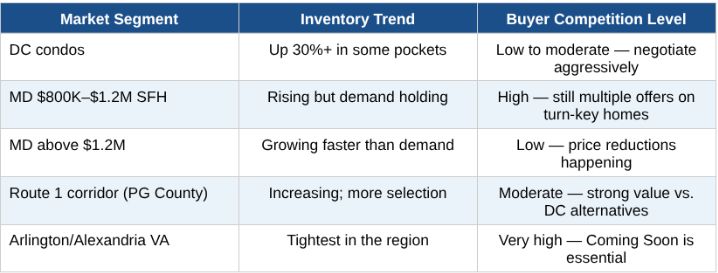
Active inventory across the DC suburbs has jumped more than 33% in key market segments as of May 2026 — and that number changes everything about how buyers and sellers along the Route 1 corridor should be approaching the market right now. More inventory means buyers have real negotiating leverage for the first time in years. It also means sellers who don’t price strategically and present well will sit. This post breaks down exactly what the shift means, street by street, in Hyattsville, College Park, Riverdale Park, and Mount Rainier.
The data comes from 94 Compass agents across DC, Maryland, and Northern Virginia, sharing real-time observations from the week of May 11, 2026. It’s not a national forecast — it’s what agents are actually experiencing in transactions right now.
Why Is Inventory Up 33%? Here’s What’s Actually Driving It
The inventory spike isn’t a sign of distress — it’s a combination of factors that have been building since late 2025. Sellers who waited out the rate environment are finally listing. New construction is delivering in some suburban pockets. And the burst of buyer demand that defined 2023–2024 has cooled into something more selective — buyers who are still very much in the market, but no longer panic-buying.
The result is a market that looks completely different depending on where you look and what price range you’re in:
If You’re a Buyer Near Route 1: Your Leverage Window Is Open
For buyers who’ve been watching the DC suburbs — specifically the Route 1 communities of Hyattsville, Riverdale Park, College Park, and Mount Rainier — this inventory jump is the opening you’ve been waiting for. But leverage only works if you know how to use it.
What “More Inventory” Actually Gets You at the Negotiating Table
When inventory was razor-thin in 2022–2024, sellers held nearly every card. Waived inspections, waived appraisals, offers $50K over ask. That market is gone in most price ranges. Here’s what buyers along Route 1 can realistically push for right now:
Seller-paid closing costs — previously almost impossible to negotiate, now increasingly common
Inspection contingencies restored — buyers are no longer forced to waive them on most homes
Price reductions on listings sitting 45+ days — average days on market across the DMV is now running 41–70 days
Repair credits before closing — sellers who need to move are often willing to negotiate condition issues rather than lose the deal
Flexible closing timelines — a powerful tool that costs you nothing but can win a deal over a higher competing offer
The 45-Day Rule: Where the Best Deals Are Hiding
With average days on market now between 41 and 70 across the DMV, any listing that’s been sitting for 45 or more days without a contract has missed its window of peak demand. That’s a buyer’s opportunity.
These “stale” listings — and there are more of them every week — are where disciplined buyers are finding the most room to negotiate. The sellers are often motivated, sometimes frustrated, and increasingly willing to consider offers that wouldn’t have gotten a response six months ago. A skilled buyer’s agent knows how to structure those offers to win without overpaying.
Why the Route 1 Corridor Is Especially Worth Your Attention Right Now
The inventory increase means more choices — and more choices along Route 1 is significant, because this corridor already offered something most DC alternatives can’t: genuine walkability, neighborhood identity, and prices that are meaningfully lower than comparable DC or Montgomery County communities.
Add to that the Purple Line’s construction progress — the light rail is approximately 90% complete with a late 2027 opening target — and you have a corridor where buyers who act before the transit line opens are buying ahead of a permanent change to the neighborhood’s transit profile. That’s the kind of upside that doesn’t show up in Zillow’s automated estimates.
The “Buy Now, Refinance Later” math for Route 1 buyers:
Mortgage rates remain elevated, but here’s the reality: when rates eventually fall, every buyer in America will flood back into the market simultaneously — driving prices back up and eliminating the negotiating leverage that exists today. Buyers who act now capture current inventory selection, today’s negotiating leverage, and the future rate benefit when they refinance. Waiting for the “perfect” rate environment often means paying more for the house.
What’s Actually Winning Offers Right Now (It’s Not Always the Highest Price)
One of the most significant findings from this week’s agent data: multiple agents reported winning deals without being the highest offer. The deciding factors were clean presentation and favorable terms — specifically “true cash” positioning or offer structures that minimized seller risk.
If you’re financing, that doesn’t mean you’re at a disadvantage — it means your offer needs to be structured thoughtfully. Flexible closing dates, a pre-approval letter from a known local lender, and a personalized approach to the offer package can move a seller more than an extra $5,000 on price.
If You’re a Seller Near Route 1: The Market Will Tell You the Truth Quickly
Sellers in Hyattsville, Riverdale Park, College Park, and Mount Rainier aren’t facing a collapsed market — but they are facing a more demanding one. Buyers have more choices now, and they’re using them. The homes that are moving are the ones that are priced accurately and show well. Everything else is sitting.
Condition Is No Longer Optional
The agent data is consistent on this point: in a market with rising inventory, “as-is” is a tough sell. Buyers who have options — and they do now — are gravitating toward turn-key homes that require minimal immediate work. That doesn’t mean you need to renovate your kitchen before listing. It means the cosmetic basics matter more than they did two years ago.
Fresh interior paint in neutral tones is one of the highest-ROI pre-listing investments
Cleaned-up landscaping and a presentable front entry are the first things buyers see — and judge
Minor repairs that would show up on an inspection report are worth addressing before listing, not after a buyer makes them a condition
Deep-cleaned, decluttered interiors photograph better and show better — and first impressions are now largely formed online before a buyer ever sets foot in the door
Don’t Just “Hit” the MLS — Phase Your Launch
One of the clearest signals from this week’s data: 100% of agents reporting new listing agreements are using Compass Coming Soon before going active on the MLS. This isn’t just a platform feature — it’s a strategic approach that protects your most valuable asset as a seller: your days-on-market count.
The 3-Phase Launch Strategy:
Phase 1 — Private Exclusive: Share your listing with qualified buyers before it’s publicly available. Zero days-on-market clock. Real feedback on price before you commit publicly.
Phase 2 — Coming Soon: Build awareness and showing requests before your active date. Buyers arrive ready to move.
Phase 3 — MLS Active: Go public with validated pricing and early momentum. Compass data shows homes marketed this way go to contract 20% faster than traditional launches.
The 14-Day Signal You Can’t Ignore
If your listing hasn’t received an offer in 14 days, the market is giving you information. The instinct is to wait it out — but in a rising inventory environment, waiting compounds the problem. More competing listings arrive every week, and buyers interpret extended days-on-market as a signal that something is wrong, even when the issue is simply price.
The right move at the 14-day mark isn’t a public MLS price cut. It’s a private price test — real-time feedback from showing agents, collected off-market, before you make any public adjustment. That intelligence tells you whether the issue is price, condition, or marketing — and lets you fix it strategically.
The Route 1 Corridor in May 2026: What’s Different Here
The Route 1 communities in Prince George's County operate with dynamics that don’t always match the broader DMV headlines. A few things that are specific to this corridor right now:
DC median prices are down 9.8% year-over-year. That creates a “value buy” narrative for buyers comparing DC options against Route 1 communities — and it’s pushing more buyer interest toward Hyattsville and adjacent neighborhoods that offer comparable walkability at significantly lower price points.
The Purple Line changes the calculus. At approximately 90% complete with a late 2027 opening target, the light rail will connect the Route 1 corridor to the broader DC Metro network in a way that’s never existed before. Buyers who purchase before the line opens are buying before the transit premium is priced in. Sellers who list after the line opens will benefit from that premium — but buyers acting now get to capture it themselves.
PG County’s dual tax structure is a real cost buyers need to understand. In Hyattsville, buyers pay both city and county property taxes. The county transfer tax sits at 1.4% — higher than most Maryland jurisdictions. First-time buyers may offset some of this through Maryland’s Pathway to Purchase program, which offers up to $10,000 in down payment and closing cost assistance. These are the hyperlocal details that national real estate sites don’t explain — and they affect your budget meaningfully.
Inventory is up here too — which is a buyer advantage. More listings in Riverdale Park, Mount Rainier, and College Park means buyers have real comparison points and less pressure to decide in 48 hours. Sellers who present well and price accurately are still moving homes. Those who don’t are sitting in a way they simply wouldn’t have two years ago.
Frequently Asked Questions
Why is inventory up 33% in the DC suburbs right now?
The increase reflects a combination of factors: sellers who delayed listing during peak rate uncertainty are now coming to market, buyer demand has moderated from its 2022–2024 peak, and the burst of competitive offers that absorbed inventory quickly has settled into more selective buying behavior. The result is more homes available, more days on market, and more negotiating room for buyers.
Does rising inventory mean home prices are dropping in Hyattsville and College Park?
Not across the board. DC median prices are down 9.8% year-over-year, which is significant. But in the Route 1 corridor specifically, prices have held more steadily — the relative affordability compared to DC proper means buyer interest from DC-priced-out shoppers continues to support demand. Well-priced, well-presented homes are still selling. Overpriced homes are not.
Is now a good time to buy near Route 1 in Prince George's County?
For buyers with a 3–7 year horizon, yes — for several specific reasons. Inventory is up, giving you more selection and negotiating leverage. DC prices are softening, pushing more buyers toward PG County alternatives. And the Purple Line’s late 2027 opening will permanently improve transit access along the corridor. Buyers who act before the line opens are ahead of that pricing shift.
How long are homes sitting on the market in the Route 1 corridor in 2026?
DMV-wide averages are running 41–70 days. Well-priced, show-ready homes in Hyattsville, Riverdale Park, and Mount Rainier can still move in under 2 weeks. Listings that are overpriced or need work are sitting longer — which is creating negotiating opportunities for buyers who know how to identify them.
What should sellers in Hyattsville or College Park do right now to get their home sold?
Three things matter most: price it accurately from day one (the market is less forgiving of high pricing than it was), present it well (buyers have options now and turn-key condition matters), and phase your launch strategically rather than going directly to MLS. Sellers who do all three are still getting strong results. Those who skip steps are sitting.
What closing costs should buyers expect in Prince George's County, Maryland?
Buyers in PG County should budget 2.5–4% of the purchase price for closing costs. That includes the 1.4% county transfer tax, state transfer taxes, title fees, and lender costs. On a $450,000 purchase, that’s roughly $11,000–$18,000. First-time buyers may qualify for up to $10,000 through Maryland’s Pathway to Purchase program — worth asking about before you write your first offer.
The Bottom Line
A 33% inventory increase in the DC suburbs is a meaningful shift — not a crisis, but a change in who holds leverage in a transaction. Buyers along the Route 1 corridor now have negotiating tools they haven’t had in years. Sellers who understand what’s changed and adapt their strategy are still winning. Those who approach this market the way they would have in 2023 are going to be frustrated.
The communities along Route 1 — Hyattsville, Riverdale Park, College Park, Mount Rainier, Edmonston — remain some of the most compelling value propositions in the entire DC metro area. Relative affordability, incoming transit infrastructure, walkable neighborhood character, and proximity to DC without DC prices. The inventory shift makes this corridor more accessible than it’s been in a while. The question is whether you have the right strategy to take advantage of it.
Buying or Selling Near Route 1? Let's Talk Strategy.
The inventory shift is real — and it changes what you should do next. Whether you're trying to negotiate your way into a home in Hyattsville, price a listing in Riverdale Park, or figure out if College Park makes sense for your budget, the answer starts with a conversation.
I'm Ryan Hehman, a licensed Maryland and DC Realtor with Compass Real Estate's Home Keys Team. The Route 1 corridor is my backyard — I know which blocks are moving, which listings are overpriced, and where the Purple Line will create the most long-term value.
Call or text: 443-990-1230
Email: Ryan.Hehman@Compass.com
Free consultations — no pressure, just local expertise.