

How Federal Layoffs Are Affecting Home Prices in Prince George's County — And What It Means If You're Buying or Selling
Federal workforce reductions have introduced real uncertainty into parts of Prince George's County's housing market in 2026 — but the picture is far more nuanced than the headlines suggest. The county is not one market. Some sub-markets along the Route 1 corridor are largely insulated because their buyer base skews toward DC commuters, University of Maryland employees, and private sector workers rather than federal employees. Others — particularly the areas closest to large federal installations — are seeing extended days on market and softer prices. If you're buying or selling in PG County right now, knowing which side of that line your neighborhood sits on is the most important piece of information you can have.
What's Actually Happening With Federal Layoffs and Housing
Since early 2025, DOGE-driven federal workforce reductions have cut more than 54,000 federal jobs across the DC region, according to the Brookings Institution. The George Mason University Fuller Institute projects an additional 20,000 downstream job losses as reduced household spending flows through service industries. In DC proper, inventory jumped more than 50% year-over-year by spring 2026, and the median sold price in DC fell more than 6% in February 2026 compared to the prior year.
Prince George's County sits in the middle of this story — not the hardest hit, but not immune either. Bright MLS data for April 2026 shows PG County with the highest median days on market among major DMV sub-markets. According to Bright MLS chief economist Lisa Sturtevant, this reflects a combination of factors: the county's above-average federal worker concentration, uncertainty driving some buyers to the sidelines, and sellers who received federal buyout packages now entering the market.
The Bright MLS Spring 2026 Finding You Need to Know
Nearly 40% of DC-area real estate agents surveyed by Bright MLS reported representing at least one client whose move was directly related to federal workforce reductions. One-third said layoffs were causing home prices to fall in their specific sub-market. PG County and DC proper had the highest median days on market in April 2026 among all DMV jurisdictions — reflecting a buyer pool that has more leverage than it has had in several years.
Where the Impact Is Real — and Where It Isn't
This is where local knowledge matters most. PG County spans 500 square miles and roughly a dozen distinct sub-markets. Federal employment concentration varies enormously across those markets, and so does the buyer pool that drives demand.
Sub-Markets with Higher Federal Exposure
Areas closer to large federal installations — Suitland, Forestville, and parts of southern PG County near Andrews Air Force Base (Joint Base Andrews) — have a buyer pool that is meaningfully more concentrated in federal employment. These are the areas where softening is most pronounced. Days on market are longer, seller concessions are more common, and pricing strategy matters more than it did even 12 months ago.
The Washington Post reported that HHS was among the hardest-hit agencies in the region, with more than 2,000 job cuts in Maryland alone — many of them in PG and Montgomery counties. The FDA's Beltsville campus and USDA research facilities in the county also represent pockets of concentration that are worth factoring into a buyer's or seller's calculus depending on their specific street address.
The Route 1 Corridor: A Different Demand Story
Hyattsville, Riverdale Park, College Park, and Mount Rainier tell a different story — and it's one that matters if you're considering buying or selling in my primary market.
The demand base along the Route 1 corridor is diversified in ways that provide a meaningful buffer against federal-sector volatility. The University of Maryland employs roughly 15,000 faculty and staff, a number that does not fluctuate with federal workforce decisions. The greater College Park area's "Discovery District" has attracted private biotech and tech sector employers whose hiring is independent of federal budget cycles. And the corridor's walkability, Metro access, and arts-district character attract buyers relocating from DC proper — a buyer pool that actually grows when DC becomes less affordable.
The College Park Economic Development Report confirmed that approximately 1,116 full-time federal workers reside in College Park — a real number, but one that represents a fraction of the city's workforce and housing demand base. The university ecosystem, private sector, and DC commuter pool are the dominant drivers of demand on the Route 1 corridor.
Route 1 Corridor: What's Insulating This Market
University of Maryland: ~15,000 faculty and staff whose employment is not tied to federal budget cycles
Private sector and biotech: Discovery District employers anchored to UMD research, not federal contracts
DC commuters priced out of Northwest DC: Route 1 is where they land, and that demand increases when DC softens
Purple Line opening (late 2026/early 2027): Transit-driven demand is building regardless of federal job counts
Arts District buyer profile: Creative professionals and young couples who self-select away from federal work culture
Sub-Market Exposure Guide: Where Federal Layoffs Are Hitting Hardest
Here's how the major PG County sub-markets break down by federal employment exposure and current market conditions. This is the comparison that buyers and sellers should be running, not the county-wide average:
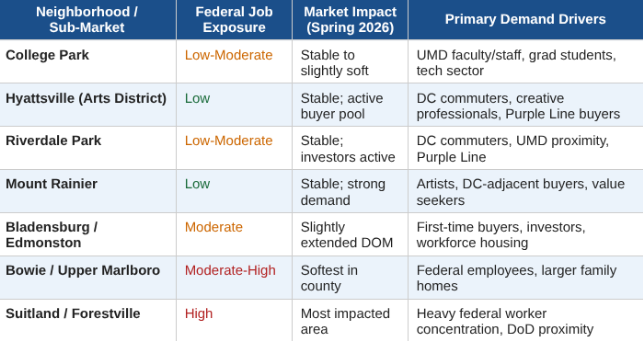
Note: "Federal Job Exposure" reflects the relative concentration of federal employees in each area's buyer and seller pool, based on proximity to federal facilities, employment data, and on-the-ground observations from active listings. This is not a definitive ranking — local conditions change, and specific streets within a neighborhood can vary.
If You're a Buyer: Why This Market Actually Works in Your Favor
The uncertainty driving some buyers to the sidelines is creating real opportunities for buyers who are financially stable and ready to move. Here is what I am seeing on the ground right now:
Seller concessions are back. After years of buyers waiving everything, sellers in PG County are now offering closing cost credits, rate buydowns, and repair allowances. This is especially true for homes that have been sitting 30 or more days — which is a growing segment of the inventory.
Days on market give you leverage. In the 2021–2022 market, every home was a 48-hour decision. Today, a home sitting 45 days in Hyattsville or 60 days in Bladensburg is a home where the seller has recalibrated their expectations. That's the window where negotiation happens.
You're buying ahead of the Purple Line. The light rail is approximately 90% complete and on track for a late 2026 or early 2027 opening. Buyers who purchase along the Route 1 corridor now are locking in pre-opening prices before transit-driven appreciation kicks in — a pattern that has played out in comparable markets around the country.
The financially stable buyer has real advantages right now. Bright MLS's own economist put it plainly: for buyers who are in a solid financial position, the spring 2026 market offers more opportunity than it has in several years. Less competition, more negotiating room, and a seller pool that includes motivated federal buyout recipients.
PG County assistance programs are still available. The Pathway to Purchase down payment assistance program, the Maryland Mortgage Program, and the Maryland HomeCredit are all active for eligible buyers. If your household income qualifies, these programs can meaningfully reduce upfront costs and monthly carrying costs — regardless of what's happening with federal employment.
If You're a Seller: Pricing Strategy Has Never Mattered More
I want to be straight with sellers who are wondering whether to list now or wait. The answer is not one-size-fits-all — it depends on your specific address, your price point, and how your home compares to recent closed sales in your micro-market.
What I can tell you with confidence is this: the sellers who are moving homes in spring 2026 are the ones who priced correctly on day one. The sellers who are sitting are the ones who priced for the 2022 market and haven't adjusted. In a market where buyers have more options and more leverage than they've had in years, overpricing is the single most costly mistake you can make.
Know your buyer pool before you set your price. A home in the Arts District of Hyattsville competes in a buyer pool dominated by DC commuters and Purple Line buyers. A home in Bowie competes in a buyer pool with more federal worker exposure. These require different pricing strategies and different marketing approaches.
The "wait it out" strategy rarely works in this environment. Buyers are tracking days on market closely. A home that sits 30 or 45 days accumulates a stigma that requires a price reduction to overcome — and that price reduction almost always wipes out any gains you were hoping to capture by waiting.
Concessions can be more strategic than price cuts. Rather than dropping your list price, consider offering a closing cost credit or rate buydown that directly addresses what's in the buyer's way. In many cases, a $10,000 seller credit toward closing costs moves a buyer who was stuck on monthly payment math without requiring a corresponding reduction in your sale price.
Compass Private Exclusive gives you a soft launch option. Before going fully public on the MLS, we can test your pricing through Compass's off-market network — reaching motivated buyers without accumulating public days on market. This is a real advantage in a market where buyers are watching DOM closely as a negotiating signal.
Spring and September are your best windows. Federal fiscal year ends September 30, which triggers relocation activity from federal workers who are transferring rather than being laid off — that buyer pool is still active. Spring is still the peak buyer demand period. If you're deciding when to list in 2026, those are the two windows where you have the most buyers competing for your home.
What This Market Is Not
There is a lot of noise in social media and national headlines about the DC housing market. Some of it dramatically overstates the situation. Here are three things worth clarifying:
Setting the Record Straight
This is not a crash. Bright MLS economists have consistently emphasized that what's happening in PG County is a normalization, not a collapse. Prices are flat to modestly declining in some sub-markets — they are not in freefall.
It is not uniform across the county. The difference between Hyattsville's buyer pool and Suitland's buyer pool is significant. County-level averages obscure more than they reveal.
Well-priced homes are still selling. Bright MLS spring 2026 data shows that homes priced correctly and presented well in the Route 1 corridor are still moving — typically within 30 to 45 days when positioned right. This is not a frozen market. It is a market that requires more precision than the last few years demanded.
Frequently Asked Questions
Are home prices dropping in Prince George's County because of federal layoffs?
Some areas are experiencing modest softening — particularly sub-markets with higher concentrations of federal workers, like parts of southern PG County near Joint Base Andrews and Suitland. County-wide, Redfin data shows PG County median prices down approximately 2.2% year-over-year as of early 2026. However, the Route 1 corridor — Hyattsville, Riverdale Park, College Park, and Mount Rainier — has held more stable because its buyer base is more diversified, drawing heavily from DC commuters, University of Maryland employees, and private sector workers.
Should I wait to buy in PG County until the federal situation stabilizes?
If you're financially stable, have secure employment outside the federal sector, and are buying for a 5+ year horizon, waiting carries its own risks. The Purple Line opening — projected for late 2026 or early 2027 — is likely to drive appreciation along the Route 1 corridor regardless of federal employment trends. And if rates drop as forecast, buyer competition will increase again, potentially erasing the negotiating leverage you have today. The relevant question is not whether the market is perfect — it's whether your personal situation is ready.
Which neighborhoods in PG County are most affected by federal layoffs?
Sub-markets closest to large federal installations and with buyer pools concentrated in government employment are feeling the most pressure. This includes parts of Suitland, Forestville, and southern PG County near Joint Base Andrews. Areas with more diversified demand bases — the Route 1 corridor, College Park, Hyattsville — are experiencing less impact because their buyers come from a broader range of employment sectors.
Is now a good time to sell in Hyattsville or Riverdale Park given the federal layoff news?
Yes, with appropriate expectations. The Route 1 corridor remains an active market for sellers who price accurately based on current 90-day comps. The buyer pool here is still motivated — particularly buyers relocating from DC proper, where the market has softened more sharply than the Route 1 corridor. The key is not to price for 2022 conditions. Homes priced right in this market are moving; homes priced above comparable sales are sitting.
How long are homes sitting on the market in PG County right now?
Across PG County, median days on market reached 67 days as of February 2026, up from 42 days the prior year — a significant increase. But this varies substantially by sub-market and price point. Well-priced, move-in-ready homes in the Arts District of Hyattsville and along the Route 1 corridor are still moving in 30 to 50 days. The longest sitting times are in higher-price-point properties and in sub-markets with heavier federal employment exposure.
What does the federal situation mean for the Purple Line and Hyattsville home values?
The Purple Line is a state and federal infrastructure project that is approximately 90% complete and on track for opening regardless of current federal workforce trends — its funding and construction timeline predate the current administration and are not contingent on federal employment levels. When it opens, it will connect the Route 1 corridor to Bethesda and Silver Spring without requiring a transfer, which is a meaningful commute improvement. That transit-driven demand dynamic is a separate story from the federal layoff headline.
Buying or Selling in PG County? Let's Talk Through Your Specific Situation.
The most important conversation you can have right now is a hyperlocal one — not about the county as a whole, but about your specific street, your specific price point, and your specific timeline.
I'm Ryan Hehman with Compass, and I work the Route 1 corridor — Hyattsville, Riverdale Park, College Park, Mount Rainier, Edmonston, and Bladensburg — along with Montgomery County and Northeast DC. I can give you a real picture of what's happening at the address level, not the county level.
Call or text: 443-990-1230
Email: Ryan.Hehman@Compass.com